- What is a CVE (Common Vulnerabilities and Exposures)?
- How CVE records are assigned and published
- Reserved vs. Published: Why some CVE IDs appear before full details exist
- How to read a CVE number
- What qualifies as a CVE (and what doesn't)
- CVE vs. CVSS vs. CWE vs. NVD: How they fit together
- Zero-days and CVEs: When exploitation comes first
- What a CVE record does not tell you
- How defenders should prioritize CVEs
- Common mistakes teams make with CVEs
- Notable CVE examples and what they taught defenders
- How to manage CVE vulnerabilities effectively
- The limits of CVE lists: Why a patch backlog isn't a defense
- How network evidence helps detect CVE exploitation
- FAQ
- The bottom line
Learn what a CVE is, how records are assigned and read, and why a CVE list alone won't protect you when patching lags behind exploitation.
If you are part of security operations, you likely already know the acronym. CVE, short for Common Vulnerabilities and Exposures, is the shared language your team uses to talk about flaws in software and hardware. It turns a vaguely described flaw into a precise, universally recognized identifier that every tool, vendor, and analyst can agree on.
This page covers what a CVE actually is, how records get created, how to read one, and where the system falls short. Most importantly, it explains what this means for your detection and response strategy, because a list of known flaws is only useful if you can act on it.
What is a CVE (Common Vulnerabilities and Exposures)?
A CVE is a public, standardized identifier for a specific security vulnerability or exposure in software or hardware. Think of it as a catalog number. Each entry gets a unique ID, a short description, and references to advisories or patches.
The program exists to solve a coordination problem. Before CVE, two vendors might describe the same flaw in completely different ways, making it nearly impossible to know if your patch, your scanner, and your threat feed were all talking about the same thing. CVE fixed that. When you see CVE-2023-4966, everyone from your vulnerability scanner to your threat intel provider is referring to the exact same issue.
A few things a CVE is, and isn't:
-
It is a unique name and a brief description of a flaw
-
It is a reference point that ties scanners, advisories, and intel together
-
It is not a full technical analysis or an exploit
-
It is not a severity score (that comes from a separate system, covered below)
For a security operations leader, the value is practical. CVEs give your team a common vocabulary that reduces confusion, speeds up triage, and lets your tools interoperate without custom translation.
How CVE records are assigned and published
The CVE Program is coordinated by MITRE and funded largely by the U.S. Cybersecurity and Infrastructure Security Agency (CISA). The work of actually assigning IDs is distributed across a network of partners, each called a CVE Numbering Authority (CNA).
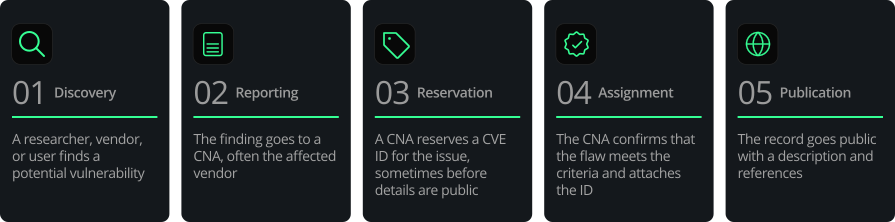
Here is the typical lifecycle:
- Discovery: A researcher, vendor, or user finds a potential vulnerability
- Reporting: The finding goes to a CNA, often the affected vendor
- Reservation: A CNA reserves a CVE ID for the issue, sometimes before details are public
- Assignment: The CNA confirms that the flaw meets the criteria and attaches the ID
- Publication: The record goes public with a description and references
A CNA is an organization authorized to assign CVE IDs within a defined scope. Major software vendors, open-source projects, bug bounty platforms, and research organizations all act as CNAs. This distributed model lets the program scale to tens of thousands of new records each year without a single bottleneck.
Records also carry a status. An entry can sit in a Reserved state while a vendor coordinates disclosure, then move to Published once the details are released. Understanding this flow matters, because a reserved-but-not-yet-published CVE can appear in advisories before your scanners and security devices have full data on it.
CVEs (Common Vulnerabilities and Exposures) are stored and maintained across two primary public repositories: The official CVE Program Database and the National Vulnerability Database (NVD).
Reserved vs. Published: Why some CVE IDs appear before full details exist
When a CNA sets aside a CVE ID before the full details of a vulnerability are ready to be shared publicly, that ID enters a Reserved state. This happens deliberately. Vendors and researchers often need time to develop a patch, notify downstream partners, and coordinate disclosure before attackers can act on the information. During that window, the ID exists in the system but the record shows little more than a placeholder.
You may encounter reserved IDs in threat intel feeds, vendor advisories, or scanner output before the full record ever goes public in the National Vulnerability Database (NVD). That is not an error; it is the disclosure process working as intended.
Once the vendor has a patch ready and coordinates public disclosure, the record moves from Reserved to Published. A published CVE includes a description of the flaw, affected versions, and references to advisories or patches, giving your scanners, threat intel feeds, and the NVD the data they need to fully process the entry.
The gap between these two states is operationally significant. Your tools may surface a reserved ID days or even weeks before the full record goes live. During that window, scanner results will be incomplete, severity scores may be absent, and your team will have limited context to work from. Treat a reserved CVE as an early warning, not background noise. Watch vendor channels and security advisories closely, and start assessing likely exposure based on the product or component involved, even before public details arrive.
CVE
The fixed prefix, marking it as a CVE Program identifier
YYYY
The year the ID was reserved or assigned (not always the year the flaw was discovered)
NNNNN
A sequential number, four digits or more, that uniquely identifies the entry within that year
Take CVE-2023-4966. The "2023" tells you the ID was assigned or reserved in 2023. The "4966" is the arbitrary sequence number. That is it. The number itself carries no severity, no product name, and no exploit detail. It is purely an address you use to look up everything else.
One useful note: The sequence portion is no longer capped at four digits. Since the volume of vulnerabilities exceeds 10,000 per year, IDs can run to five digits or more. Do not assume a short number means an old or minor flaw.
What qualifies as a CVE (and what doesn't)
Not every bug earns a CVE. The program has specific criteria, and understanding them helps you interpret what a CVE assignment actually signals.
To qualify, a vulnerability generally must be:
- Independently fixable: It can be remediated separately from other flaws
- Acknowledged by the affected vendor, or documented in a way that confirms its security impact
- Affecting a single codebase or product: Flaws in multiple products typically receive separate IDs
What typically does not get a CVE:
- Bugs with no security impact (a crash that leaks nothing sensitive)
- Issues in a product the vendor no longer supports and won't acknowledge
- Configuration mistakes that are the operator's responsibility rather than a flaw in the software itself
There is an important nuance in the name: Vulnerabilities and Exposures. A vulnerability is a weakness an attacker can exploit directly, such as a buffer overflow that grants code execution. An exposure is a mistake or condition that gives an attacker indirect access or information, such as a setting that leaks data even though nothing is technically broken. Both matter to defenders, and both can receive a CVE.
CVE vs. CVSS vs. CWE vs. NVD: How they fit together
These four acronyms get mixed up constantly, yet each plays a distinct role. Getting the distinctions right sharpens how your team prioritizes work.
| Standard | What it covers | Who maintains it | Question it answers |
|---|---|---|---|
|
CVE (Common Vulnerabilities and Exposures) |
A unique identifier and description for a specific flaw |
MITRE and the CNA network | Which vulnerability? |
|
CVSS (Common Vulnerability Scoring System) |
A numerical severity score from 0.0 to 10.0 |
FIRST | How bad is it, in theory? |
|
CWE (Common Weakness Enumeration) |
A classification of the underlying weakness type |
MITRE | What kind of flaw is this? |
|
NVD (National Vulnerability Database) |
Enriched CVE records with CVSS scores and CWE mappings |
NIST | Where do I get the full, analyzed record? |
Here is how they connect in practice. A CVE gets an ID and description. The NVD then ingests it, assigns a CVSS score to convey severity, and tags it with a CWE to describe the weakness class. So a single flaw might be CVE-2023-4966, scored 9.4 in CVSS, classified under a CWE for exposure of sensitive information, all discoverable through the NVD.
For a SecOps leader, the key insight is that CVSS is a starting point, not a verdict. A 9.8 that no attacker is exploiting in your environment may be less urgent than a 7.5 with active exploitation against your exposed assets. Severity and risk are related, but they are not the same thing.
Zero-days and CVEs: When exploitation comes first
A zero-day is a vulnerability that attackers are exploiting before a patch exists, and often before a CVE has been publicly documented. The name reflects the time defenders have had to respond: Zero days.
Zero-days complicate the CVE model in a specific way. A CVE ID may not exist yet when exploitation begins. In some cases, the attack is discovered first, and the CVE is assigned afterward to name the vulnerability it targeted. In others, a reserved ID exists but carries no public details, leaving defenders with a signal but no context.
Operationally, a patch-and-scan strategy always fails to address zero-day threats. Relying exclusively on known CVEs leaves defenses completely blind to active exploits before they are publicly disclosed. This systemic risk for SOCs is magnified in the age of Mythos, where attackers can leverage the power of AI to discover vulnerabilities that have long evaded human detection. As a result, the accelerating speed and scale of these emerging threats consistently outpace the operational capacity of traditional patching and remediation timelines. Rather than relying solely on vulnerability signatures, network visibility and behavior-based detection enable your team to identify exploitation patterns even without a formal CVE or patch. Regardless of whether an underlying flaw is officially cataloged, an in-progress exploit inherently leaves visible evidence on the network.
What a CVE record does not tell you
A CVE record is a starting point, not a complete picture. Understanding what it leaves out is just as important as knowing what it contains.
Whether you are actually affected. A CVE describes a flaw in a specific product or version. It does not know which software your organization runs, how it is configured, or whether the vulnerable component is even reachable. Confirming actual exposure requires mapping the CVE to your asset inventory and validating that the affected version is present and accessible.
Whether exploitation is happening in your environment. A CVE record documents that a vulnerability exists. It says nothing about whether an attacker has already used it against you. Detecting active exploitation requires behavioral monitoring, specifically network evidence and endpoint telemetry that can surface the attack patterns a CVE enables.
Whether compensating controls already reduce your risk. You may already have mitigations in place that limit exposure, such as network segmentation, a web application firewall, restricted access to the vulnerable interface, or behavioral detection rules. A CVE record does not account for any of these. Your actual risk may be lower than the CVSS score suggests, or higher, depending on your environment.
Whether a patch fully removes attacker access after compromise. Applying a patch closes the vulnerability. It does not evict an attacker who is already inside. CitrixBleed is the clearest example: Patching the session token leak left stolen sessions valid and active. Remediation after a potential compromise has to include hunting for signs of prior exploitation, terminating suspect sessions, and validating that no persistence mechanism was established during the exposure window.
A CVE is the name of the problem. Answering these four questions is how you determine your actual exposure and response obligation.
How defenders should prioritize CVEs
A security tool or scanner that returns thousands of CVEs is not giving you a to-do list. It is giving you raw material that still requires judgment. The defenders who reduce the most risk are the ones who prioritize systematically rather than by score alone.
Exploitability. A CVE with a public proof-of-concept exploit, or one that CISA has added to its Known Exploited Vulnerabilities catalog, demands faster action than a theoretical flaw with no known attack path. Active exploitation in the wild compresses your response window significantly.
Internet exposure. A vulnerable service facing the open internet carries fundamentally different risk than the same flaw on an internal system behind multiple layers of access control. Prioritize CVEs on any asset with a public-facing attack surface, especially management interfaces, authentication endpoints, and collaboration tools.
Asset criticality. Not every system is equal. A vulnerability on a server that holds sensitive customer data, runs a core business process, or anchors your identity infrastructure deserves more urgency than the same flaw on a development workstation. Weight severity by what the affected asset actually does, not by the CVSS number in isolation.
Compensating controls. A CVE on a system protected by network segmentation, a web application firewall, or behavioral detection rules carries lower immediate risk than one on an unprotected, fully exposed asset. Factor in your existing controls before deciding where to focus remediation effort. This does not mean deprioritizing indefinitely; it means sequencing your work intelligently.
Signs of active abuse. Threat intel feeds, NDR detections (including behavioral and anomaly detection), and endpoint telemetry can all surface indicators that a specific CVE is being exploited in your environment right now. Any signal of active abuse moves a CVE to the top of the queue, regardless of its CVSS score. Detection has to run alongside remediation so your team knows when theory has become reality.
The goal is a single, normalized priority queue your analysts can trust, rather than five different tools returning conflicting severity scores for the same flaw.
Treating CVSS as risk.
CVSS measures theoretical severity. It does not measure your actual exposure, the exploitability of the flaw in practice, or the value of the asset at risk. A 9.8 on a system no attacker can reach is not your most urgent problem. A 6.5 on an internet-facing authentication endpoint that is actively being probed may be. Use CVSS as one input, not the final answer.
Assuming patching equals protection.
A patch closes a vulnerability. It does not undo a compromise that already happened, and it does not guarantee that no attacker acted during the window between disclosure and deployment. After patching a vulnerability tied to a high-severity CVE, your team should still hunt for indicators of exploitation that may have occurred beforehand.
Ignoring exposed management interfaces.
CVE-2023-20198 in Cisco IOS XE was exploited through a web management interface left exposed to the internet. This is a recurring pattern. Management consoles, administrative panels, and remote access interfaces represent high-value targets, and any CVE affecting them deserves immediate attention. Restricting access to these interfaces is a foundational control that limits the blast radius of a wide range of CVEs.
Tracking CVEs without validating affected assets.
A CVE in your security tool or scanner output means little until you confirm which of your assets actually runs the affected software version. Without that validation step, your team spends time remediating systems that were never vulnerable, while genuinely exposed assets wait. Asset inventory accuracy is not a nice-to-have; it is the foundation of a functioning CVE program.
Notable CVE examples and what they taught defenders
The best way to understand CVEs is to look at the ones that reshaped how teams defend. Each of these taught a hard lesson.
Log4Shell (Log4j, CVE-2021-44228). A remote code execution flaw in a logging library buried inside thousands of applications. The lesson: Your attack surface includes dependencies you never chose directly. Every vulnerability scanner now hunts for Log4j, and the incident permanently raised the profile of software supply chain risk.
CitrixBleed (Citrix NetScaler, CVE-2023-4966). This flaw let attackers bypass multi-factor authentication and hijack legitimate user sessions over HTTP. The lesson: A "session token leak" sounds mild until it hands an attacker an authenticated foothold. Patching alone wasn't enough, because stolen sessions stayed valid, so defenders also had to terminate active sessions.
Confluence authorization bypass (CVE-2023-22518). An improper authorization flaw that let an unauthenticated attacker reset Confluence and create an administrator account. The lesson: Internet-facing collaboration tools are prime targets, and privilege escalation flaws can hand over the whole application in one request.
Cisco IOS XE backdoor (CVE-2023-20198). A vulnerability in the web management interface of Cisco IOS XE, exploited in the wild to plant backdoors on exposed devices. The lesson: Management interfaces should never face the open internet, and network infrastructure itself is a target, not just endpoints and servers.
The common thread across all four: knowing the CVE existed was never the hard part. Detecting whether it was being exploited in your environment, before or after a patch, was where teams either succeeded or got breached.
How to manage CVE vulnerabilities effectively
Managing CVEs at enterprise scale is a prioritization problem, not a patching problem. You will never clear the entire list, so the goal should be to reduce the most meaningful risk first. A disciplined program looks like this:
The step most teams underinvest in is prioritization. When a scan returns thousands of findings, treating them all as equal is a recipe for alert fatigue and tool sprawl. Normalize severity across your sources into a single, consistent scale so analysts can trust one prioritized queue rather than reconciling conflicting scores from five different tools. New agentic triage tools can be helpful here as well, surfacing a complete attack kill chain rather than isolated alerts.
Integration can also make a difference here. When your vulnerability data, endpoint detection, and network evidence feed a centralized view, your team spends less time pivoting between consoles and more time reducing risk. That directly improves both mean time to detect (MTTD) and mean time to respond (MTTR).
The limits of CVE lists: Why a patch backlog isn't a defense
A CVE list tells you what is known to be vulnerable. It says nothing about what is currently being attacked in your environment. That gap is where a purely patch-focused strategy breaks down.
Consider the realities every SecOps leader lives with:
- Patching takes time: Testing, change windows, and business continuity constraints mean critical patches can sit for days or weeks.
- Zero-days exist by definition: Attackers exploit some flaws before any CVE or patch is published.
- Patches don't undo compromise: As CitrixBleed showed, applying the fix doesn't evict an attacker who already has a valid session.
- Not every flaw gets a CVE: Some vulnerabilities are never assigned an ID, so they never appear in your list at all.
The uncomfortable truth is that a patch backlog is a to-do list, not a security control. Between the moment a CVE is disclosed and the moment you finish patching every affected asset, you are exposed. And a large backlog quietly expands that window of risk across your entire estate.
This is why detection has to run alongside remediation. You need to know when someone is attempting to exploit a CVE, whether or not you have patched it yet, and whether or not a patch even exists.
How network evidence helps detect CVE exploitation
Endpoints and logs are essential, but they leave gaps. Unmanaged devices, cloud workloads, IoT, and ephemeral instances often can't run an agent, and attackers know it. The network, by contrast, sees everything that communicates. That makes network evidence one of the strongest ways to catch CVE exploitation in progress. Insider activity also looks normal to endpoint security, but network evidence can surface anomalous behavior that signals a possible attack in progress.
Here is what network-based detection gives your operations team:
The payoff is proactive response. When a new critical CVE lands, your team can immediately search network evidence for signs of exploitation across the whole environment, rather than waiting for patch cycles to finish. Pair that with severity normalization, endpoint enrichment that can offer context and visibility, and the ability to verify and isolate a compromised device in the network. Together, these capabilities convert a static CVE list into an active defense.
That is the shift worth making: Treat CVEs as intelligence that drives and enhances detection, not just a queue of patches to grind through. Known vulnerabilities plus real-time network evidence give you a far lower risk profile than either one alone.
Which format is used for CVE naming?
CVE IDs follow the format CVE-YYYY-NNNNN. "CVE" is a fixed prefix, "YYYY" is the year the ID was reserved or assigned, and "NNNNN" is a unique sequence number of four or more digits. For example, CVE-2023-4966 was assigned in 2023 with sequence number 4966. The number carries no severity or product information on its own; it is simply a unique address for looking up the full record.
How do I fix a CVE vulnerability once it's identified?
Start by confirming which of your assets actually run the affected software. Apply the vendor's patch or update as the primary fix. When you can't patch immediately, use mitigations such as disabling the vulnerable feature, restricting network access, or isolating the asset. After remediating, verify the fix worked and keep monitoring for exploitation attempts, since some flaws, like session-hijacking bugs, require additional cleanup such as terminating active sessions.
How do I improve CVE triage and response?
Improve CVE triage by prioritizing real-world risk rather than CVSS score alone, weighting exploitability, exposure, and active exploitation. Normalize severity across your detection sources into a single scale so analysts work from one trusted queue, and enrich detections with host context that correlates each entity’s alerts into an overall risk rating. Integrate your workflow with case management so escalations create incident tickets automatically. Together, these steps reduce false positives and shorten MTTR. Agentic triage can also assist in automating these tasks, freeing SOC analysts to focus on high-priority risks.
Can you detect exploitation of a CVE before a patch is available?
Yes. With NDR generating network evidence, it’s possible to detect exploit attempts based on the malicious traffic patterns they generate, regardless of whether a patch exists. Because NDR threat detection can watch for the attack behavior rather than relying on the fix, you can identify exploitation of zero-days and unpatched flaws in real time. This removes the exposure window between disclosure and remediation, which is exactly where patch-only strategies leave you blind.
What is the best way to track CVE vulnerabilities?
Combine continuous scanning against an accurate asset inventory with a feed of new CVE records enriched by CVSS and CWE data from the NVD. Map each relevant CVE to the specific assets it affects, then manage everything through a centralized view rather than scattered tool consoles. Use NDR to layer in network monitoring and visibility with active exploitation intelligence so your tracking reflects real risk, not just theoretical severity, to catch what scanners miss.
Does every security vulnerability get a CVE?
No. A flaw generally qualifies only if it is independently fixable, acknowledged by the affected vendor or otherwise documented as a security issue, and tied to a specific product. Bugs with no security impact, issues in unsupported products, and pure configuration errors often never receive an ID. This is one reason a CVE list can never be your complete view of risk, and why threat detection and network visibility matter alongside vulnerability tracking.
Who assigns CVE IDs, and can anyone report a vulnerability?
CVE IDs are assigned by CNAs, or CVE Numbering Authorities, which are organizations authorized to issue IDs within a defined scope. These include major software vendors, open-source projects, bug bounty platforms, and research organizations, all coordinated under MITRE. Anyone can report a vulnerability, typically to the affected vendor or to a relevant CNA, which then determines whether it qualifies and assigns an ID.
What's the difference between a vulnerability and an exposure?
A vulnerability is a weakness an attacker can exploit directly, such as a flaw that grants remote code execution. An exposure is a condition or mistake that gives an attacker indirect access or information, such as a misconfiguration that leaks sensitive data even though nothing is technically broken. The CVE Program covers both, because each can be part of how an attacker reaches their goal.
The bottom line
A CVE is the shared identifier that lets your tools, teams, and vendors talk about the same flaw with precision. But a list of known vulnerabilities is only as valuable as your ability to act on it. Track CVEs against real assets, prioritize by actual risk, and pair remediation with network-based detection so you can catch exploitation whether or not a patch exists yet. That combination turns a static catalog into a measurable reduction in risk.
Ready to close the gap between known vulnerabilities and active defense? See how network evidence strengthens your CVE detection and response.
Book a demo
We’re proud to protect some of the most sensitive, mission-critical enterprises and government agencies in the world. Learn how Corelight’s Open NDR Platform can help your organization mitigate cybersecurity risk.