
Complete detection coverage
Illuminate and disrupt evasive attacks with the industry’s most complete multi-layer detection engine. Combine the power of AI/ML with threat intelligence and file analysis to defend against evolving threats.
Multi-layered threat detection
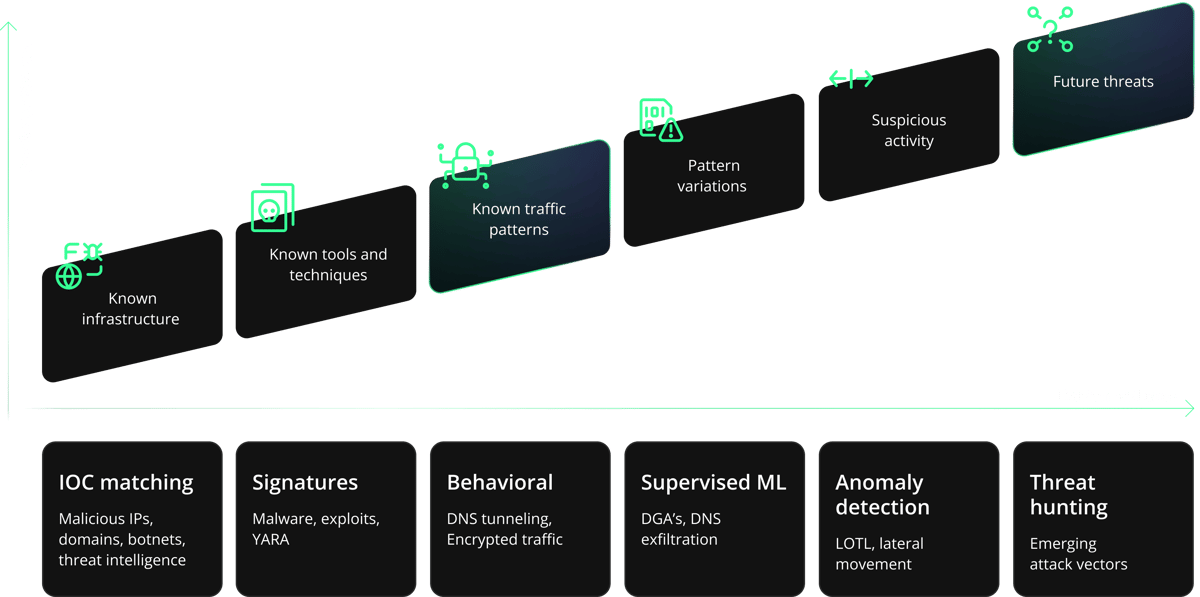
Corelight delivers comprehensive MITRE ATT&CK® framework coverage by fusing machine learning, behavioral analytics, and curated signatures to expose evasive, novel, and encrypted threats. Corelight’s explainable machine learning detections leverage Zeek®-based behavioral analysis to deliver detailed logs for precise threat hunting and defensible compliance across the full attack lifecycle.
Unified, tunable detections: From known threats to machine learning
EDR evasion and encrypted traffic coverage
Detect post-exploitation behavior and threats that evade endpoint controls, such as credential access, DNS tunneling, Shadow AI, and anomalous SMB usage. See and detect across east-west traffic, unmanaged devices, and encrypted sessions where EDR often has blind spots.
High-fidelity, low-noise alerts
Targeted detections for high-value threat behaviors like lateral movement, C2 communication, encrypted traffic misuse, and exfiltration that are precise and context-aware, dramatically reducing false positives.
Transparent and customizable AI/ML models
Transparent Zeek-based detections with full logs and packet evidence. Enable or disable individual models, set per-model thresholds, and adjust ignore lists to cut noise. See behavior before and after every anomaly. Triage starts with evidence, not questions.
Use cases
Lateral movement — the attacker is already inside and spreading
Corelight exposes attackers attempting to spread internally by establishing behavioral baselines that instantly flag anomalous RDP and SSH connections, unauthorized admin file share access, and unexpected internal executable downloads. This gives your SOC immediate visibility into east-west threat progression before an adversary can establish a permanent foothold.
Command and control — the attacker phones home quietly
Corelight uncovers quiet phone-home infrastructure by analyzing network telemetry for hidden HTTP C2 frameworks, malicious SSL certificates, Tor connections, and subtle patterns like NXDomain beaconing or DGA activity. It strips away the attacker’s cover, exposing stealthy command channels even when they are intentionally disguised as normal web traffic.
Data exfiltration — the data is leaving, disguised as normal traffic
Discover IOCs and TTPs used in sophisticated attacks with curated Zeek-powered detection packages. Analyze network traffic with exceptional precision using high-fidelity detections and enrichments to illuminate the digital breadcrumbs adversaries leave behind. By exposing signs of compromised hosts, unauthorized transfers, and infections in real time, Corelight gives your team the decisive intelligence needed to act quickly.
Credential theft — the attacker steals the keys instead of breaking the lock
Corelight exposes east-west credential compromise by flagging Kerberos abuse, NTLM anomalies, and admin share manipulation that often slip past traditional endpoint (EDR) tools. By continuously monitoring native authentication protocols, Corelight alerts your team the moment an attacker tries to use stolen credentials to move across your environment.
Admin exploitation — the attacker uses your own tools against you
Corelight thwarts Living-off-the-Land (LotL) tactics by using advanced baselining to catch adversaries turning legitimate administrative tools, subnets, and SSH connections against you. It transforms seemingly normal internal network activity into highly visible, actionable anomalies your team can trust and investigate.
Ransomware detection — the attacker will hold your data hostage
Corelight strengthens ransomware defense by providing clear visibility into network activity missed by endpoint solutions. Advanced analytics allow security teams to spot early signals of ransomware, such as unusual lateral movement or suspicious external communications. By generating rich evidence across RDP, SSH, and SMB traffic, Corelight reveals threats before encryption occurs. This real-time detection empowers defenders to quickly respond to ransomware threats, minimizing overall impact and reducing recovery time.
Gartner® and Peer Insights™ are trademarks of Gartner, Inc. and/or its affiliates. All rights reserved. Gartner Peer Insights content consists of the opinions of individual end users based on their own experiences, and should not be construed as statements of fact, nor do they represent the views of Gartner or its affiliates. Gartner does not endorse any vendor, product or service depicted in this content nor makes any warranties, expressed or implied, with respect to this content, about its accuracy or completeness, including any warranties of merchantability or fitness for a particular purpose
It's been a breath of fresh air compared to the black box AI tools that dominate the NDR market. The data fidelity is unmatched... I can see exactly why a detection fired.

Manager of IT Services, IT Services Industry
Gartner® and Peer Insights™ are trademarks of Gartner, Inc. and/or its affiliates. All rights reserved. Gartner Peer Insights content consists of the opinions of individual end users based on their own experiences, and should not be construed as statements of fact, nor do they represent the views of Gartner or its affiliates. Gartner does not endorse any vendor, product or service depicted in this content nor makes any warranties, expressed or implied, with respect to this content, about its accuracy or completeness, including any warranties of merchantability or fitness for a particular purpose
Corelight provides exceptional insight into our network traffic patterns, helping us detect sophisticated network threats that bypass traditional security controls.
Senior Security Analyst, IT Services Industry
True security requires defensible outcomes
Don’t rely on opaque models, proprietary risk scores, or summarized data. Corelight pairs comprehensive multi-layered analytics with preserved ground-truth network evidence. Its deterministic, protocol-level analysis eliminates false-positive noise, empowering your team to instantly trace any alert back to the exact sessions, files, and packets involved.
| Darktrace | Vectra AI | ExtraHop | Corelight |
| Relies heavily on unsupervised ML to model "normal" behavior and surface anomalies. Detection logic is largely opaque and difficult to decompose. | Combines ML with behavior-based analytics focused on attacker techniques and privilege misuse. Detection layers exist but are abstracted into risk scores and models. | Uses analytics and ML to identify suspicious activity primarily from real-time traffic and metadata. Detection engines are fewer and tuned for speed. | Combines AI/ML, behavioral analytics, anomaly detection, curated signatures, YARA, and threat intelligence, operating on preserved network evidence, not summarized data. |
| Darktrace | Vectra AI | ExtraHop | Corelight |
| Alerts provide conclusions and AI-generated narratives, but limited access to the underlying network transactions that triggered the alert. Analysts are asked to trust the model. | Provides behavioral context and timelines, but little direct access to full protocol-level evidence. Limited ability to pivot into the original network data. | Shows packet-derived metadata and transaction summaries, but raw protocol context is often short-lived and constrained to appliance-local storage. | Every alert is supported by direct, inspectable network evidence: Sessions, files, protocols, and artifacts. Analysts trace any detection back to the exact network events that caused it, enabling immediate validation, confident escalation, and defensible reporting. |
| Darktrace | Vectra AI | ExtraHop | Corelight |
| Behavioral detections are generated from statistical baselines and probabilistic ML models, leading to a high alert volume. | Risk scores are derived from behavioral models that infer attacker intent. Analysts cannot independently determine whether a scored alert reflects a real attack or a baseline deviation. | Behavioral analytics are tied to proprietary metadata rather than deep protocol semantics. Some behavioral signals inherently carry higher false-positive rates. | Behavioral detections analyze protocol-level semantics deterministically. This produces high-confidence verdicts that significantly reduce false positive rates without sacrificing detection coverage. |
Unlocking multi-layered threat detection
AI/ML
detections
Integrate advanced machine learning and behavioral anomaly detection with deterministic, protocol-level logic to expose sophisticated threats. Corelight’s AI/ML engine operates directly on preserved, ground-truth network evidence to deliver high-confidence, fully explainable verdicts.

Detection Collections
Supercharge your telemetry with pre-packaged collections that combine proprietary, high-throughput scaling with curated community expertise. Unmask novel C2 patterns, audit encrypted traffic without decryption, track assets, and monitor complex ICS/OT environments. Structured intelligence layers deliver immediate depth to detections and threat-hunting workflows.

Intrusion Detection
Identify known threats with speed and precision across the entire network. Corelight’s curated signatures integrate high-performance Suricata IDS to deliver a robust first line of defense against known malware, C2 infrastructure, and exploitation attempts.

Threat Intelligence
Adapt to evolving attacks by combining premium, hourly-updated intelligence with high-fidelity network evidence. Corelight identifies known and unknown threats with superior accuracy while reducing the manual effort and alert fatigue associated with low-fidelity data feeds.
Maximize ROI with services and training from Corelight
Corelight Services and Training puts elite defense within reach by ensuring your team can maximize the value of our Open NDR Platform. From precision deployment and SIEM integration to activity-based training from world-class experts, our services provide the technical guidance needed to accelerate SOC maturity.
-
Accelerate implementation and time to value with health checks
-
Precision engineering for detection calibration, and customization
-
Expert-led training and education services

FAQ
What is AI threat detection?
AI threat detection, also known as AI-driven threat detection, uses artificial intelligence (AI) to identify potential cybersecurity threats. These threats may include malware, ransomware, phishing, insider threats, network intrusion, and other malicious activity. It often relies on machine learning (supervised and/or unsupervised) to analyze large volumes of data (network traffic logs, system logs, etc.) for patterns, unusual activity, anomalies, and other possible indicators of compromise (IOCs). Unlike traditional methods of threat detection (signature-based engines, regex patterns, IOC matching, and other rule-based systems), AI threat detection can be trained to learn from new data and behaviors as they evolve. It can also detect new and never-before-seen threats for which no signature or pattern yet exists, enabling proactive threat hunting.
What is machine learning in cybersecurity?
Machine learning (ML) is a subcategory of artificial intelligence (AI) that involves training computer models, or algorithms, to recognize highly complex patterns. This process is similar to, but not the same as, rational decision making. The creation, training, and tuning of these models depends on experts who specialize in computer science, data science, or a combination of the two disciplines.
Why is AI necessary in cybersecurity?
Artificial intelligence (AI) is affecting every industry and enterprise in both the near and long term. The cybersecurity industry has been an early adopter and testing ground for many AI use cases, helping define both the possibilities and challenges the technology delivers. Cyber attackers are using AI to launch more sophisticated attacks. Defenders, in turn, must use AI-based tools across their security portfolios to proactively hunt for threats, analyze complex data sets, and accelerate and automate decisions.
What are YARA rules?
YARA (aka "Yet Another Recursive Acronym") is a tool designed for file analysis, identification and classification of malware based on textual and binary patterns. Its tongue-in-cheek name notwithstanding, YARA has been an important part of cybersecurity toolkits since it launched on GitHub in 2013. It is open source, which means that a broad community of security experts and organizations contribute to YARA rule sets while simultaneously using it in the field to test suspicious code and confirm malware types found in digital environments.
What is anomaly-based detection?
Anomaly-based detection, sometimes known as behavior-based detection, is a method that uses data analysis and rules to help identify evidence of potential malicious activity in digital systems. Unlike signature-based detection, which focuses on known indicators of compromise (IOC), anomaly-based detection does not search for known malware characteristics. Instead, it establishes a baseline for normal network behavior and, through continuous tuning and adaptation, identifies patterns that may be evidence of malicious activity.