- What is a supply chain attack?
- How supply chain attacks work
- How supply chain attacks are changing with AI
- Types of supply chain attacks
- Notable supply chain attack examples
- Why supply chain attacks are so hard to prevent
- How to protect against supply chain attacks
- Detecting supply chain attacks after initial compromise
- How Corelight helps detect supply chain attacks
- FAQs
Supply chain attacks bypass perimeter defenses through trusted, signed software. See how they work, real examples, and how to detect them.
What is a supply chain attack?
A supply chain attack is a cyberattack vector that targets an enterprise indirectly by compromising a trusted third-party vendor, software library, hardware component, or service provider. Rather than attempting to breach a well-fortified target directly, threat actors compromise upstream dependencies within the software development lifecycle (SDLC), hardware supply chain, or partner servicing or supporting the attack target(s).
In modern IT environments, software is rarely built from scratch. Applications rely on a variety of open-source code, third-party APIs, and CI/CD (Continuous Integration and Continuous Delivery) automation tools. Supply chain attacks exploit these implicit trust boundaries. Once an attacker embeds malicious code, backdoors, or compromised updates into a commercial product or software an organization uses, the attack payload bypasses traditional perimeter defenses (e.g., firewalls and email gateways) through trusted, often digitally signed, installations.
How supply chain attacks work
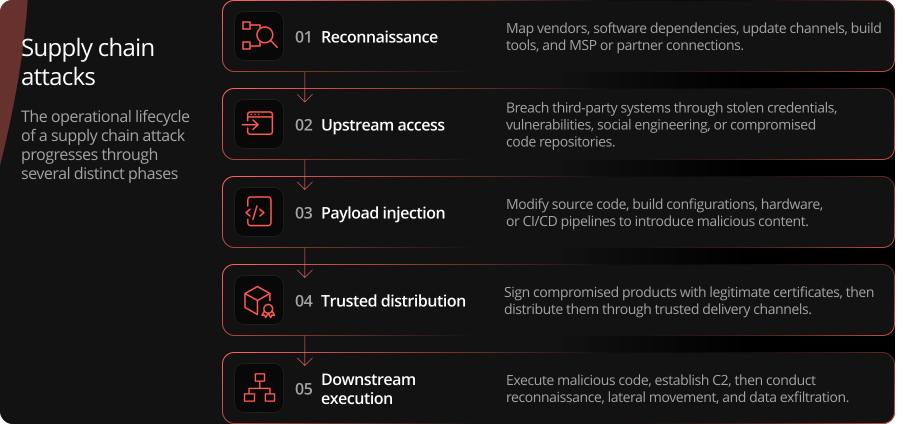
The operational lifecycle of a supply chain attack progresses through several distinct phases:
- Reconnaissance: Map targets, and their software ecosystems, dependencies, update channels, build tools, and MSP or partner connections.
- Upstream initial access: The adversary breaches the third-party target via stolen credentials, unpatched vulnerabilities, social engineering, or the compromise of source code repositories (e.g., GitHub, GitLab).
- Payload injection & build pipeline tampering: Threat actors modify source code, alter build configurations, or inject malicious content into hardware or the CI/CD pipeline before compilation.
- Distribution via trusted channels: The compromised product, now unwittingly containing malicious code, is signed with legitimate digital certificates for verification and distributed through pre-approved mechanisms to downstream victims.
- Downstream execution & post-exploitation: Upon installation or execution, the malicious code initializes, and begins a campaign of further malicious actions (e.g., internal reconnaissance, lateral movement across downstream corporate networks, and exfiltration).
How supply chain attacks are changing with AI
Artificial intelligence has fundamentally altered the economics and speed of software supply chain operations. Threat actors use generative AI and LLM-driven agents to automate vulnerability discovery across millions of lines of open-source code, construct hyper-targeted spear-phishing campaigns against key third-party developers, and automate generation of attacks at scale.
Crucially, the threat vector can extend to autonomous agentic models and AI model poisoning. As a capability example, Anthropic’s Claude Mythos Preview model can read complex codebases, autonomously discover zero-day vulnerabilities, and construct multi-step exploit chains in hours that historically took human researchers weeks. AI supply chain attacks now target the AI infrastructure itself with attackers poisoning training datasets, compromising model weights on open repositories like Hugging Face, or deploying Trojanized fine-tuned weights ("model poisoning") to hijack enterprise decision-making pipelines.
Types of supply chain attacks
Supply chain risks can show up in a variety of ways throughout the hardware and software lifecycle:
- Software dependency exploitation: Tactics like typosquatting (naming malicious packages similarly to popular ones) and dependency confusion (tricking package managers into pulling public malicious packages instead of private internal ones) target package registries, the repositories that store and manage collections of software libraries, packages, and dependencies.
- Compromised build pipelines (CI/CD Tampering): Injecting malicious code directly into software pipeline build agents or modifying compiler tools during build execution (e.g., SolarWinds SUNBURST).
- Stolen or compromised signing certificates: Stealing legitimate code-signing keys to sign malware, ensuring operating systems treat the malicious payload as trusted, verified software.
- Hardware & firmware implantations: Altering hardware microcode, UEFI/BIOS firmware, or physical componentry on motherboard assemblies before delivery.
- Service provider / managed service provider (MSP) pivots: Breaching a service provider partner to gain remote administrative control over a specific target customer environment, customer data, or a range of target customer access mechanisms (e.g., via Remote Monitoring and Management tools).
Notable supply chain attack examples
Several high-impact supply chain breaches over recent years highlight the evolution of these tactics:
- Lazarus Group npm campaigns (2024-2025): North Korea state-sponsored actors distributed malicious open-source software via compromised NPM (Node Package Manager) packages, deploying custom malware like BeaverTail and InvisibleFerret to target developer systems and cryptocurrency/DeFi platforms.
- Shai-Hulud (2024): A self-replicating worm campaign targeting open-source package repositories like NPM to compromise developer environments and downstream software dependencies.
- XZ Utils backdoor (2024): A multi-year social engineering effort where a malicious maintainer inserted a complex backdoor into the widely used
XZ-Utilsdata compression library, targeting SSH daemons across Linux distributions. - 3CX (2023): A multi-stage cascading supply chain attack where a compromised financial software installer (X_TRADER) led to the breach of 3CX's desktop VOIP app installer, which was subsequently digitally signed and distributed to millions of users.
- Kaseya VSA (2021): The REvil ransomware group exploited zero-day vulnerabilities in Kaseya’s VSA (Virtual System Administrator) software for managed service providers to deploy ransomware across hundreds of downstream businesses simultaneously.
- Codecov (2021): Attackers gained access to Codecov's Bash Uploader script, modifying it to harvest sensitive credentials, tokens, and API keys from customer CI/CD environments.
- SolarWinds (2020): Russian state-sponsored actors compromised SolarWinds' Orion Build System, injecting the SUNBURST backdoor into updates distributed to over 18,000 public and private organizations.
Implicit trust
Endpoint security and EDR solutions frequently whitelist signed software binaries from trusted software vendors, creating blind spots.
Deep transitive dependencies
Modern applications rely on nested open-source libraries. Auditing direct dependencies is straightforward, but auditing deep, indirect transitive dependencies is nearly impossible manually.
Vendor environment blind spots
Organizations often lack direct visibility into or administrative control over third-party development environments, build systems, or partners' security postures beyond initial due diligence.
Defensive asymmetry
Defenders must secure thousands of internal and external code dependencies, while an adversary needs only a single compromised library or credential to infiltrate the pipeline.
How to protect against supply chain attacks
Mitigating supply chain risks requires a zero-trust approach combined with rigorous pipeline controls and automated defenses:
- CI/CD hardening & code signing verification: Enforce strict access control on build servers, sign all build artifacts, and enforce cryptographic hash verification prior to deployment.
- Software Bill of Materials (SBOM): Maintain comprehensive, real-time inventories of all third-party and open-source components across all internally developed applications.
- Vendor risk management: Mandate third-party security audits, strict SLA compliance, and zero-trust remote access for external contractors, 3rd-party service personnel, and MSPs.
- Stakeholder security awareness: Have security and operational teams, as well as employees using related applications, monitor for suspicious or unusual activity that might portend an evolving attack.
- Defensive AI application: Security teams can leverage specialized AI models to perform continuous Application Security Testing (AST), automatically diffing code updates against established baselines to identify anomalous signatures or suspicious patterns in open-source pull requests before integration.
Detecting supply chain attacks after initial compromise
Because supply chain attacks leverage legitimate, code-signed software, perimeter and signature-based prevention mechanisms may fail to detect the initial deployment or execution of malicious code. Consequently, effective detection relies heavily on behavior-based threat detection by observing post-compromise behaviors:
Anomalous process execution
Monitoring signed applications that generate unexpected child processes, such as execution of PowerShell or WMI queries.
Lateral movement detection
Tracking unusual SMB, SSH, or RPC connections originating from server infrastructure that hosts third-party services.
Network traffic intelligence
Detecting unusual outbound command-and-control (C2) connections, DNS tunneling, or abnormal data transfers via Network Detection and Response (NDR).
How Corelight helps detect supply chain attacks
Corelight’s Open NDR Platform provides comprehensive and context-rich network data that serves as the single source of truth for all security operations. This high-fidelity evidence, built on the open-source Zeek standard, provides unparalleled breadth by capturing important details of every connection, including from blind spots like East-West and encrypted traffic) that can reveal post-compromise activity associated with supply chain compromises:
What is the best solution for detecting supply chain attacks with network traffic?
Advanced Network Detection and Response (NDR) solutions provide an ideal defense by generating rich, protocol-level network evidence to identify anomalous outbound C2 traffic, unexpected DNS queries, and unusual lateral movement from trusted applications.
What is the difference between a software and hardware supply chain attack?
A software supply chain attack compromises source code, CI/CD pipelines, software libraries, or update binaries. A hardware supply chain attack tampers with physical components, microcode, or firmware during manufacturing, assembly, or distribution.
Can EDR detect supply chain attacks?
EDR can detect supply chain attacks, but primarily during the post-exploitation phase, such as when a compromised binary attempts privilege escalation, memory injection, or lateral movement. EDR often misses initial execution if the compromised software is trusted and digitally signed by an approved certificate authority.
What is an SBOM and how does it help?
A Software Bill of Materials (SBOM) is a formal, structured inventory of all components, open-source libraries, and dependencies within a software application. It helps security teams rapidly identify whether their environment contains software impacted by disclosed CVEs or recognized supply chain vulnerabilities.
Are MSP supply chain attacks common?
Yes, MSP supply chain attacks are common. Managed Service Providers (MSPs) are high-value targets because compromising a single MSP grants threat actors administrative access to hundreds of downstream client networks simultaneously through remote management tools.
What is the MITRE ATT&CK technique for supply chain attacks?
Supply chain compromise is categorized under MITRE ATT&CK as Technique T1195 (Supply Chain Compromise), which includes sub-techniques T1195.001 (Compromise Software Dependencies and Development Tools), T1195.002 (Compromise Software Supply Chain), and T1195.003 (Compromise Hardware Supply Chain).
Book a demo
We’re proud to protect some of the most sensitive, mission-critical enterprises and government agencies in the world. Learn how Corelight’s Open NDR Platform can help your organization mitigate cybersecurity risk.