Zeek
Hunting Citrix NetScaler zero-days with Corelight
Learn how to use Zeek logs and Corelight Investigator to discover Citrix NetScaler assets, monitor DTLS traffic, and hunt for zero-day exploitation...
Ruby’s November 18 security releases address seven flaws across string case conversion and regular-expression processing. At the time of writing, GHSA-34m4-m9fh-gqp5, the first advisory in the Ruby announcement, has been assigned CVE-2026-132825. Some security vendors have dubbed the issue “Ruby2Shell.” For this vulnerability, Ruby’s maintainers report working proof-of-concept exploits that achieve remote code execution (RCE) under some conditions. Ruby2Shell is the latest in a string of shell vulnerabilities discovered this past month following PHP2Shell and Node2Shell.
In affected single-byte encodings such as ISO-8859-1 and Windows-1252, the German sharp S (ß) occupies one byte. Ruby converts it to SS when uppercasing, requiring two output bytes. The vulnerable loop can proceed with only one byte of buffer space remaining. A crafted string can therefore cause the second byte to be written outside the heap allocation. Ruby’s fix changes the check to require room for both bytes.
The severity assessments differ: Ruby labels its advisory Critical, and MITRE’s CNA record gives the issue a High rating with a 7.4 CVSS 3.1 score. The CNA vector specifies local access, while the middleware behavior below provides an HTTP input path. Assessing exposure therefore requires examining how requests reach the Ruby runtime, alongside its patch status.
Rack, the open-source library that Rails, Sinatra, and most other Ruby web frameworks are built on, defines the interface between Ruby web applications and web servers and includes request-processing middleware. Its method-override middleware uppercases the _method form value, while its multipart parser can apply a charset supplied with that field. On an affected runtime, these operations can bring attacker-controlled text to the vulnerable case-conversion code. An application’s default UTF-8 setting alone does not establish how every submitted field is processed.
Multipart provides a valid pre-authentication trigger path when this middleware runs before access checks. Ruby’s advisory confirms working RCE proofs of concept in some scenarios, but successful RCE remains target- and build-specific. Triggering the overflow alone does not demonstrate code execution.
The following upstream releases contain the fixes for all seven issues in Ruby’s announcement:
| Ruby branch | Versions requiring an update | Patched release |
|---|---|---|
| 3.3 | 3.3.0 through 3.3.13 | 3.3.14 |
| 3.4 | 3.4.0 through 3.4.12 | 3.4.13 |
| 4.0 | 4.0.0 through 4.0.9 | 4.0.10 |
| 3.2 and earlier | End-of-life branches included in Ruby’s affected-version notice | No upstream fix; migrate to a supported branch |
Ruby confirms the status of these branches in its release announcement. A distribution may backport a fix without adopting the corresponding upstream release number, so include the package revision and distribution security notice in patch verification.
Check all internet-facing Ruby applications, including Rails and classic-style Sinatra services, whether your team built them or they came bundled with another product. Ruby-based applications worth checking include Chatwoot, Discourse, GitHub Enterprise Server, GitLab, Mastodon, and OpenProject. Their inclusion here is an inventory recommendation, not confirmation that every installation is exploitable. Establish which Ruby build each deployment runs and whether its request handling exposes the affected operation.
Perform version checks in the service’s actual execution environment. An administrator’s shell, an application container, and a background worker may use separate Ruby installations. Record each runtime rather than treating the host’s ruby -v output as representative of every workload.
Corelight Open NDR Platform customers have received three new Suricata® rules via Corelight feed updates for HTTP multipart activity associated with Ruby case-conversion exploitation attempts:
| SID | Alert message |
|---|---|
| 3001009 | CORELIGHT EXPLOIT CVE-2026-132825 Ruby2Shell Method-Override Charset Upcase Memory Corruption |
| 3001010 | CORELIGHT EXPLOIT CVE-2026-132825 Ruby2Shell Charset Upcase Byte-Run Memory Corruption Trigger |
| 3001011 | CORELIGHT ATTACK CVE-2026-132825 Ruby2Shell Heap-Groom Prewarm Artifact |
The first two rules address method-override and byte-run patterns associated with the memory-corruption trigger. The third identifies a heap-grooming prewarm artifact. These alerts identify suspicious request content or supporting activity; they do not confirm successful code execution.
Zeek® is an open-source network monitoring platform whose logs are a key part of the forensic-grade network evidence that powers Corelight Open NDR. Corelight customers can obtain a custom Zeek® package for CVE-2026-132825 to load into their deployment. Contact your Customer Success team or Technical Account Manager (TAM) for access.
HTTP-content detection requires visibility into the relevant multipart headers and request body. Sensors need access to plaintext HTTP or traffic made available after Transport Layer Security (TLS) termination or decryption. Encrypted TLS traffic alone does not expose this content.
Zeek® can log HTTP request headers and POST request bodies, so you can search past traffic for these requests. Corelight customers need the custom http-headers bundle (or equivalent) to log headers and must enable HTTP POST Bodies in their policy to log request bodies.
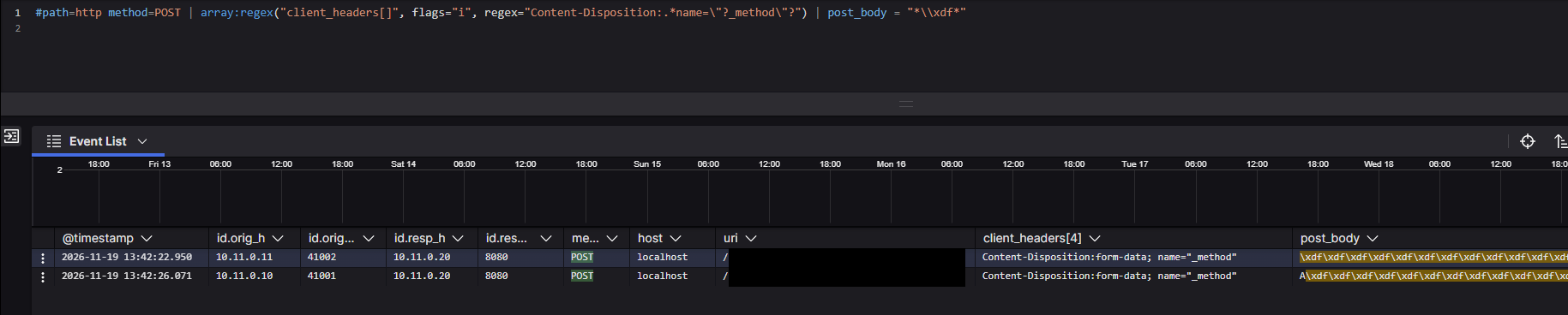
The following LogScale query finds POST requests that contain a multipart field named _method and a sharp S byte in the logged body. It works with common field names from the packages/bundles above:
The query matches \xdf, which is how Zeek writes the single-byte ISO-8859-1 and Windows-1252 encoding of ß in its logs. Treat results as leads for reviewing the full request and the target's Ruby runtime, not as confirmation of exploitation.
The following results show exploitation attempts in a lab environment:
Replace the interpreter used by each affected service with a fixed version from the table, or a later fixed release. For containerized workloads, build and deploy replacement images. Restart web and worker processes, then confirm the runtime version inside each updated workload. Changes limited to application gems do not address this runtime defect.
When Ruby is supplied with an application, follow that product’s supported upgrade procedure and verify that the update includes a fixed runtime or backported patch. During any delay, reduce the set of systems that can reach the service, for example by enforcing an IP allowlist or requiring VPN access. Access restrictions are temporary exposure controls, not a repair for the memory-corruption flaw.
Patching Ruby is the fix. In the meantime, network evidence shows whether exploitation attempts are reaching unpatched services. Corelight Open NDR Platform customers can use these Suricata rules and the Zeek® detector to spot those attempts, and forensic-grade network evidence behind them to investigate.
To keep up with future detection packages from our Corelight team, subscribe to our newsletter at the bottom of our blog feed. For more helpful information like this, check out our blog.