- Key takeaways
- What is threat detection coverage?
- Why detection coverage matters for security posture
- What good threat detection coverage looks like
- The layers of detection coverage (and how to measure each)
- Common detection coverage gaps
- How to improve threat detection coverage across on-prem and cloud infrastructure
- How NDR platforms improve threat detection coverage
- How Corelight supports threat detection coverage
- Turning detection coverage into a plan, not a score
- FAQs
Threat detection coverage isn't a single score. Learn how to measure six layers, identify gaps, and improve coverage across on-prem and cloud infrastructure.
Attackers only need to find one gap. Defenders need to find every gap that matters. Threat detection coverage is the discipline of answering that question honestly, not with a single score, but with a clear picture of what a security team can see, detect, and respond to across both on-prem and cloud infrastructure alike.
Key takeaways
- Threat detection coverage is the extent to which a security program can reliably observe, detect, and act on adversary behavior. It is a picture built from multiple layers, not a single number.
- Coverage is most often reported against MITRE ATT&CK as a blended score, such as the percentage of techniques covered with a set of detections. Other frameworks, including the NIST Cybersecurity Framework (CSF) and the cyber kill chain are sometimes used instead, but the blended-score problem appears regardless of which framework a team picks.
- Real coverage spans six layers: Asset coverage, telemetry, detection logic, alert fidelity, validation, and response are each assessed on their own terms rather than averaged into one figure.
- Coverage gaps cluster at predictable points: Unmanaged assets, cloud blind spots, encrypted traffic, activity between systems, and detections never revalidated.
- Closing these gaps requires layered telemetry across on-prem and cloud infrastructure. Network detection and response (NDR) closes several gaps at once because it sees the network, where endpoint detection and response (EDR) and other host-based tools cannot.
What is threat detection coverage?
Definition and framing
Threat detection coverage is the extent to which a security program can reliably observe, detect, and act on adversary behavior. It is a function of what a team can see (telemetry), what it can recognize (detection logic), and how quickly it can act once something fires (response). This is the loop that threat detection and response (TDR) platforms are built around.
Coverage is often framed against MITRE ATT&CK, since it offers a shared, technique-level vocabulary. But ATT&CK isn’t the only lens: NIST CSF's Detect function is often used for program-level conversations, the cyber kill chain frames coverage around the sequence of an attack, and MITRE D3FEND, the Diamond Model, and the unified kill chain show up in more intelligence-driven programs. Whichever framework a team anchors to, the question is the same: how much of what an adversary might do can we see and act on?
How coverage is typically measured today
A common practice is to report coverage as a set of MITRE ATT&CK techniques with any associated detection rule, often visualized as a heat map in the ATT&CK Navigator or a similar security information and event management (SIEM) dashboard. Overall threat coverage is often reported as the percentage of MITRE ATT&CK techniques covered by the security measures in force at the SOC.
The flaw is that this approach counts detections per technique, not depth or reliability. Five shallow, overlapping endpoint detections on one technique count the same as five spanning distinct telemetry layers, even though the latter is far more resilient to an attacker disabling any one of them.
Why detection coverage matters for security posture
Strong, well-distributed coverage shortens dwell time. Every gap gives an attacker more time to establish persistence, move laterally, or stage data for exfiltration undetected. Closing gaps is one of the most direct ways to reduce breach impact.
Strong coverage also supports proactive threat hunting, since analysts can search telemetry for evidence of specific techniques rather than waiting for an alert.
Coverage is also a more credible way to communicate posture to a board than raw tool counts or alert volume. Showing which layers are strong or weak gives leadership a more honest basis for prioritizing investment.
Risk-prioritized
Built around techniques most relevant to the organization's actual threat profile, not a generic checklist.
Multiple detection methods
Use IOCs, signatures, behavioral, anomaly, and machine learning, rather than relying on a single technique.
Spans hybrid environments
Strong across both on-prem and cloud environments, rather than strong in one and absent in the other.
Continuously tested and refined
Validated against current attacker behavior, not assumed to still work.
Tied to response
A detection that never leads to action doesn't reduce risk.
Measurable
Assessed with metrics appropriate to each layer, not one blended score.
It’s worth saying plainly: 100% detection coverage isn’t realistic. New techniques emerge, environments change, and some activity is inherently harder to observe than others. The goal isn’t a perfect scorecard. Instead, it’s a clear-eyed view of where the real gaps are.
The layers of detection coverage (and how to measure each)
Rather than a single score, detection coverage is better understood as a chain of six layers: asset coverage, telemetry coverage, detection logic, alert fidelity, validation, and response. Taken together, these layers loosely align with the Detect function of the NIST Cybersecurity Framework.
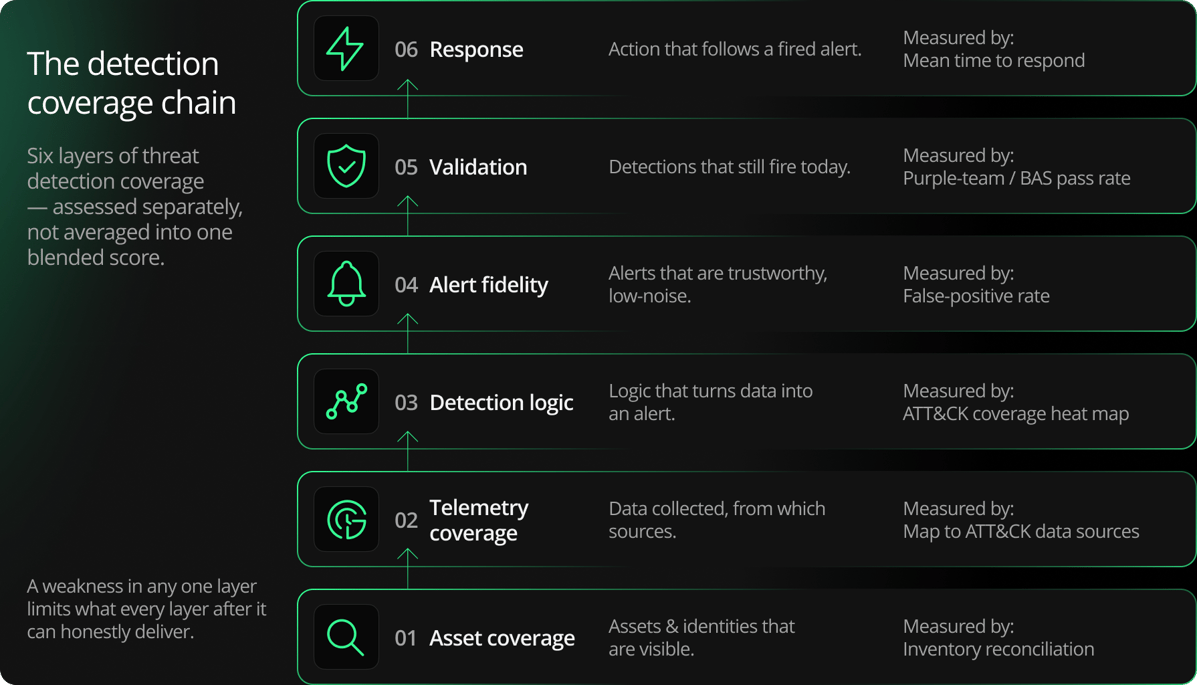
Figure: The Detection Coverage Chain: Six layers of threat detection coverage, each assessed on its own terms rather than averaged into one blended score.
| Layer | What it covers | How to assess it |
|---|---|---|
|
Asset coverage |
Which assets, identities, and workloads exist and are visible to security tools |
Reconcile asset inventories across Configuration Management Database (CMDB) and Cloud-native resources; count unmanaged devices |
|
Telemetry coverage |
Whether the data needed to observe a technique is being collected, and at what fidelity |
Map telemetry sources against ATT&CK's data-source requirements; check retention |
|
Detection logic |
Whether logic exists to turn telemetry into a fired alert for a given technique |
Build an ATT&CK Navigator heat map; assess method diversity, including IOC, signature, behavioral, anomaly, machine learning (ML) detections |
|
Alert fidelity |
Whether alerts are trustworthy, low-noise, and resistant to tampering |
Track false-positive, true-positive rates; measure signal-to-noise ratio |
|
Validation |
Whether existing detections still fire against current attacker behavior |
Run purple-team exercises; measure breach and attack simulation (BAS) pass rate, track time since last tested |
|
Response |
Whether a fired alert reliably leads to timely, effective action |
Measure mean time to respond; assess containment integration coverage |
The key point is that a blended score obscures layer-specific gaps. Each layer should be assessed separately, but not identically. Some layers score cleanly as a percentage (asset coverage, detection logic); others are better tracked as maturity tiers or time-since-last-tested (validation, response).
The goal isn’t a perfect scorecard across all six layers. It’s knowing which layer is currently weakest, since a weakness at any point in the chain limits what every layer after it can honestly deliver.
Common detection coverage gaps
Coverage gaps cluster at a handful of predictable points across the chain:
- Asset gaps: Unmanaged or shadow assets that never make it into an inventory, so no detection ever gets built for them.
- Telemetry gaps: Cloud and hybrid blind spots, encrypted traffic, reliance on a single telemetry source, and logs that can be tampered with or disabled.
- Behavior gaps: Activity between systems, like lateral movement or command-and-control, rather than on any single system. This is where EDR and NDR differ most: EDR sees the platform (process, file, and registry activity on one host), while NDR sees the network (the connections that host makes to everything around it). Cross-system activity is typically invisible to a single-host view.
- Engineering gaps: Tool sprawl, where overlapping tools cover the same techniques while others go untouched.
- Validation gaps: Detections built once and never revalidated against current attacker behavior.
- Measurement gaps: Alert volume mistaken for coverage. A high count says nothing about whether the alerts that matter are firing.
How to improve threat detection coverage across on-prem and cloud infrastructure
Improving detection coverage tends to follow a consistent sequence, regardless of environment:
- Inventory assets across both environments, reconciling the on-prem CMDB with the cloud asset inventory.
- Map priority assets and identities to ATT&CK techniques by environment, since on-prem and cloud often face different technique sets.
- Map available telemetry to those techniques separately for on-prem and cloud, since the two rely on different data sources and have different blind spots.
- Verify and close telemetry gaps by checking completeness, quality, retention, and integrity across key sources, then continue across network, cloud control-plane, identity, and encrypted traffic. Look beyond just one category.
- Validate detections continuously with purple-team exercises or BAS, and measure alert fidelity and response readiness, not just whether a rule exists.
- Include identity, admin, and cross-environment attack paths, and ensure 24/7 SOC coverage wherever risk requires it.
How NDR platforms improve threat detection coverage
Network detection and response doesn’t replace the six-layer chain. NDR strengthens several links at once, because it sees the environment from a different vantage point than host-based tools.
At the asset coverage layer, NDR provides agentless visibility into unmanaged devices, IoT/OT equipment, and cloud-native workloads. It helps close gaps around unmanaged assets and partially addresses cloud blind spots at the workload level.
At the telemetry coverage layer, network telemetry doesn’t depend on an agent, and modern NDR can analyze encrypted traffic behaviorally without decrypting it, closing gaps tied to encrypted traffic and single-source blind spots.
At the detection logic layer, the distinction is clearest: EDR sees the platform, including process, file, and registry activity on a host. NDR sees the network: The connections a host makes to every other system around it. Lateral movement, command-and-control, and exfiltration happen between systems, leaving their clearest evidence on the network. NDR addresses this with native detections that can span IOC, signature, behavioral, anomaly, and machine-learning methods.
At the alert fidelity layer, network evidence is harder to tamper with or disable than endpoint logs because it doesn’t rely on an agent an attacker could evade, kill, or blind. That reduces false positives and eases the burden on alert triage teams.
At the validation layer, network evidence serves as forensic ground truth, confirming whether existing detections still fire against current attacker behavior. At the response layer, NDR increasingly integrates with EDR and identity platforms for one-click containment.
None of this makes NDR a replacement for EDR, or vice versa. NDR and EDR are complementary, an arrangement most mature security operations centers (SOCs) extend further with a SIEM, forming what's commonly called the SOC visibility triad. A coverage chain with multiple telemetry sources is materially stronger than one that relies on any single source.
How Corelight supports threat detection coverage
Corelight applies a multilayered detection approach that natively combines indicators of compromise (IOCs), signature matching, behavioral analysis, TTP (tactics, techniques and procedures) analysis, supervised machine learning, and anomaly detection. Many NDR vendors instead treat behavioral or ML detection as an add-on to a primary signature engine.
The table below maps Corelight’s differentiators to each layer of the Detection Coverage Chain and the gap categories introduced above.
| Layer | Corelight differentiator | Gap(s) addressed |
|---|---|---|
|
Asset coverage |
Agentless coverage across on-prem and cloud, with nothing to deploy on every asset |
Unmanaged/shadow assets; cloud and hybrid blind spots |
|
Telemetry coverage |
Built on the open-source heritage of Zeek® with protocol-level transaction logs, ML detection models, and encrypted traffic analysis without decryption |
Encrypted traffic; single-source blind spots |
|
Detection logic |
The only NDR combining IOCs, signatures, behavioral/TTP, supervised ML, and anomaly detection natively, rather than as add-ons |
Evasive activity, including between-systems activity (lateral movement, C2) |
|
Alert fidelity |
Curated threat intelligence (CrowdStrike-powered IOCs, updated hourly), alert correlation, plus transparent, tunable AI with reasoning and evidence behind every detection |
Evidence integrity; alert volume mistaken for coverage |
|
Validation |
“Ground truth” network evidence used to validate alerts from other tools, e.g., CrowdStrike Charlotte AI validating host behavior |
Single-source blind spots; detections never revalidated |
|
Response |
One-click containment integrations (CrowdStrike, Microsoft Entra) plus Agentic Triage, which auto-investigates high-risk entities |
Direct support for response workflows |
Turning detection coverage into a plan, not a score
Attackers only need to find one gap. Defenders need to know where their gaps are, and that starts with avoiding the pitfall of collapsing six different questions into one blended score. Asset coverage, telemetry coverage, detection logic, alert fidelity, validation, and response each fail for different reasons, and each needs its own fix. A weakness anywhere in the chain limits what every layer after it can honestly deliver, no matter how strong the rest of the program looks on paper.
The fastest way to make progress isn’t a bigger dashboard; it’s finding the layer that’s currently weakest and starting there. For many teams, telemetry is a logical place to start because missing data limits every downstream layer. NDR is one of the few investments that strengthens multiple layers at once (asset, telemetry, alert fidelity, validation, and response) because it sees the network where host-based tools cannot. That makes it a practical place to start, whatever the rest of the chain looks like today.
How do I improve threat detection coverage?
Improving threat detection coverage requires a systematic, layered approach that prioritizes visibility and continuous validation over simple metrics. Start by inventorying assets and mapping telemetry to MITRE ATT&CK techniques to see where gaps actually sit, rather than relying on one blended percentage. From there, close telemetry gaps across sources (network, cloud control-plane, identity, encrypted traffic), continuously test detections with purple-team exercises or BAS, and tune alert fidelity and response workflows.
How can I improve threat detection coverage and visibility across both on-prem and cloud infrastructure?
Reconcile your on-prem CMDB with your cloud asset inventory so unmanaged assets don’t fall through the cracks. Then map telemetry to ATT&CK separately for each environment, since they rely on different data sources and have different blind spots. Agentless network telemetry extends visibility to unmanaged devices and cloud workloads without requiring an agent on every asset. Consider using NDR if you lack visibility in cloud and hybrid environments.
How does detection coverage improve overall security posture?
Strong, risk-prioritized coverage shortens attacker dwell time by closing the gaps adversaries rely on to operate undetected, directly reducing breach impact. It also gives leaders a more credible way to communicate posture to the board than raw tool counts or alert volume. AI-powered detections also help defend against threats that are not only evasive but also AI-driven, using AI to find new vulnerabilities and increase both the volume and speed of attacks.
What are the best NDR platforms to improve threat detection coverage?
The strongest platforms combine multiple detection methods natively (IOCs, signature, behavioral, anomaly, ML) =. They also provide agentless visibility into unmanaged devices and cloud workloads, and generate tamper-resistant network evidence. Avoid platforms that offer only one or two detection methods or treat behavioral detection and machine learning as add-ons.
What’s the difference between EDR and NDR when it comes to detection coverage?
EDR sees the platform, including process, file, and registry changes on a host. NDR sees the network, including the connections that host makes to everything around it. Single-system techniques tend to be well covered by EDR, while between-systems techniques, like lateral movement and exfiltration, leave clearer evidence on the network. Neither covers the full ATT&CK matrix alone; they are complementary and required rather than substitutes.
How does Corelight’s detection coverage compare to other NDR vendors?
Corelight is the only NDR combining IOCs, signatures, behavioral/TTP, supervised ML, and anomaly detection natively, rather than offering only one or two detection layers. Corelight’s ML is tunable and pairs every detection with network evidence for explainability, which builds trust and lowers false positives. It’s built on Zeek's open-source heritage for protocol-level transaction logs, uses curated threat intelligence with transparent AI reasoning, and provides “ground truth” network evidence other tools can use to validate their own alerts.
Book a demo
We’re proud to protect some of the most sensitive, mission-critical enterprises and government agencies in the world. Learn how Corelight’s Open NDR Platform can help your organization mitigate cybersecurity risk.