- Key takeaways
- What SOC efficiency means, and how it differs from SOC effectiveness
- Why SOC efficiency has become a priority
- How to measure SOC efficiency: Key metrics and benchmarks
- Common bottlenecks that drain SOC efficiency
- Proven strategies to improve SOC efficiency
- How AI improves security operations center efficiency
- Mistakes to avoid when optimizing for speed
- How to build a SOC efficiency improvement plan
- How Corelight helps SOC teams work more efficiently
- FAQs
Learn what SOC efficiency means, how to measure it, which bottlenecks drain it, and proven strategies to fix them, including where AI helps.
Most security operations centers aren’t struggling because they lack tools. They're struggling because their tools generate more work than their analysts can handle. When alert volumes outpace headcount, efficiency becomes the difference between catching a breach in minutes or discovering one months later. This guide defines SOC efficiency, shows you how to measure it with the right metrics, diagnoses the most common bottlenecks, and walks through proven strategies to fix them, including a realistic view of where AI helps and where it doesn’t.
Key takeaways
- SOC efficiency measures how well your security operations team converts time and resources into meaningful security outcomes.
- Core metrics include MTTD, MTTR, mean time to triage (MTTT), alert-to-close ratio, and true/false-positive rates.
- The biggest efficiency drains are poor signal quality, manual triage workflows, and a lack of network-level evidence.
- Automation accelerates SOC efficiency only when it targets the right tasks. Start with enrichment and triage, not response.
- Measuring efficiency without also tracking effectiveness leads to fast but shallow security operations.
What SOC efficiency means, and how it differs from SOC effectiveness
SOC efficiency measures how quickly and cost-effectively your security team moves from alert to resolution. It answers the question, “Are we making the best possible use of analyst time and budget?”
SOC effectiveness, by contrast, measures whether your team actually stops threats. It answers a different question, “Are we detecting the right things and preventing real damage?”
Efficiency vs. effectiveness in one line: An efficient SOC closes tickets fast. An effective SOC resolves the right tickets fast, and catches the ones that never triggered an alert in the first place.
You need both. A team that resolves alerts in seconds but misses advanced threats isn’t effective. A team that catches every threat but takes days to respond isn’t efficient. The goal is operational efficiency that amplifies rather than undermines detection and response quality.
Why SOC efficiency has become a priority
Three forces are pushing security operations efficiency to the top of the agenda:
-
Alert volumes are growing faster than headcount. The average SOC processes thousands of alerts per day, yet security hiring hasn’t kept pace. As each analyst is forced to handle more alerts per shift, efficiency determines whether the team stays ahead or falls behind.
-
Attacker breakout times are shrinking the response window. Modern attackers move from initial access to lateral movement in hours, not weeks. A SOC that takes days to triage and investigate gives adversaries time to entrench.
-
Budgets demand measurable ROI. Security leaders face increasing pressure to justify spending. Demonstrating improvements in SOC operational efficiency, such as fewer analyst hours per incident and lower cost per resolution, is now a board-level conversation.
How to measure SOC efficiency: Key metrics and benchmarks
You can’t improve what you don’t measure. The following metrics form the foundation of any SOC efficiency measurement program:
| Metric | Formula | What it reveals | What “good” looks like |
|---|---|---|---|
|
MTTD (mean time to detect) |
Total detection time ÷ number of incidents |
How quickly you spot real threats | Minutes to low single-digit hours |
|
MTTR (mean time to respond)
|
Total response time ÷ number of incidents |
How quickly you contain and remediate | Under 4 hours for critical incidents |
|
MTTT (mean time to triage)
|
Total triage time ÷ number of alerts |
How quickly analysts determine if an alert is real | Under 10 minutes per alert |
|
True-positive rate |
Confirmed incidents ÷ total alerts investigated |
Signal quality of your detection stack | Above 50% |
|
Alert-to-close ratio |
Alerts closed ÷ alerts received (per shift) |
Whether the team keeps pace with inflow | ≥ 1.0 (no backlog growth) |
|
Analyst utilization |
Hours on investigation ÷ total hours worked |
How much time goes to high-value work vs. admin overhead | Above 60% |
How to calculate MTTD and MTTR

MTTD: Subtract the timestamp when the threat first occurred (e.g., initial compromise) from the timestamp when the SOC confirmed its existence. Sum across all incidents and divide by the count.

MTTR: Start the clock at confirmed detection and stop it when the threat is fully contained and remediated. Sum across all incidents and divide by total count.
Track both over time. A downward trend usually means your security team efficiency is becoming more efficient. A flat or rising trend signals that something in your process, tooling, or staffing needs attention.
Common bottlenecks that drain SOC efficiency
Knowing your metrics is step one. Diagnosing why they stall is step two.
| Bottleneck | Symptoms | Fix |
|---|---|---|
|
High false-positive rate |
Analysts spend most of their time dismissing noise; morale drops; real alerts get buried |
Tune detection rules; add network-level context for validation; correlate alerts across data sources |
|
Manual enrichment |
Every alert requires analysts to pivot across 5+ tools to gather context before making a decision |
Deploy automated enrichment that pre-attaches asset, user, and network evidence to each alert |
|
Lack of network visibility |
Investigations stall because there’s no packet-level evidence to confirm or dismiss suspicion |
Add network evidence from NDR sensors that provide protocol-parsed metadata and Smart PCAP |
|
Siloed data |
Analysts switch between disconnected tools, losing time and context on every pivot |
Consolidate telemetry into a single SIEM or data lake with normalized fields |
|
Undefined triage criteria |
Different analysts handle identical alerts differently; no standard for escalation vs. closure |
Codify alert triage playbooks with explicit decision trees and severity definitions |
|
Unbalanced tier structure |
Tier 1 overwhelmed with low-value work while senior analysts wait for escalations |
Automate tier 1 triage decisions where confidence is high; route ambiguous cases to humans |
Example: The annual cost of false positives
Suppose your SOC receives 500 alerts per day, and your false-positive rate is 70%. That’s 350 non-actionable alerts daily. If each false positive takes an analyst 15 minutes to investigate and dismiss:
-
Daily waste: 350 × 15 min = 5,250 min = 87.5 analyst-hours
-
Annual waste: 87.5 × 365 = 31,937 analyst-hours
-
At $75/hour fully loaded: $2.4 million per year spent investigating alerts that aren’t real
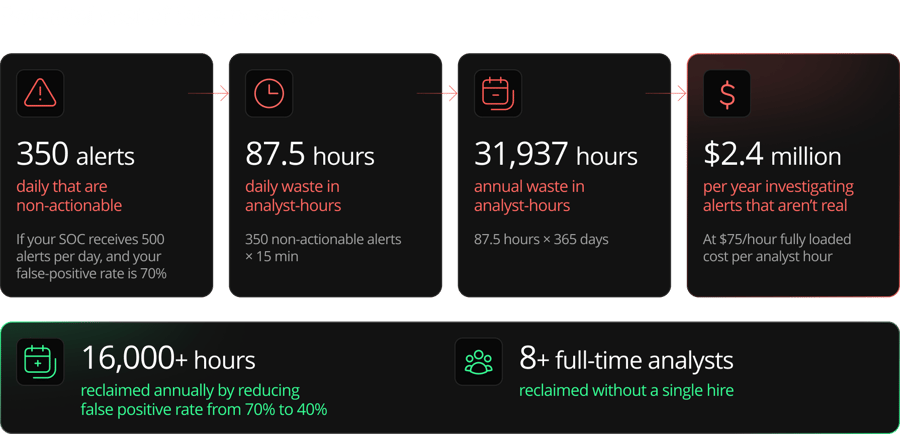
Reducing your false-positive rate from 70% to 40% would reclaim over 16,000 analyst-hours annually—the equivalent of roughly eight full-time analysts without a single hire.
Proven strategies to improve SOC efficiency
1. Fix signal quality before adding automation
The most impactful efficiency gain isn’t faster triage; it’s fewer alerts that need triaging in the first place. Audit your detection rules quarterly. Disable rules that produce only noise. Correlate alerts across multiple data sources so a single high-confidence notification replaces five low-confidence ones.
2. Automate enrichment, not decisions
Automatically attach asset context (owner, criticality, OS, patch status), historical alert data, and network session details to every alert before an analyst touches it. This eliminates the “swivel-chair” problem where analysts spend more time gathering context than analyzing threats.
3. Deploy network-level evidence
Endpoint telemetry alone leaves blind spots, especially for lateral movement, encrypted command-and-control traffic, and cloud workload communication. Adding network visibility from an NDR platform gives analysts ground-truth evidence to confirm or dismiss alerts in seconds rather than minutes.
4. Implement tiered automation with human checkpoints
Not every SOC task benefits equally from automation. Prioritize:
-
Automate first: Alert deduplication, IOC lookups, reputation checks, ticket creation, known-good dismissals
-
Automate with human review: Containment actions (isolating a host, blocking a domain), escalation routing
-
Keep human-led: Novel threat investigation, threat hunting, incident communication, policy decisions
5. Standardize and codify playbooks
Document triage and response workflows for your top 20 alert types. Include decision criteria, enrichment sources, escalation triggers, and expected time-to-close. Standardization reduces variance between analysts and makes it possible to identify process bottlenecks through metrics.
6. Measure and reduce context-switching
Track how many tool pivots an analyst makes per investigation. Each pivot adds cognitive load and time. Consolidate views, integrate tools through APIs, and surface relevant context in a single pane wherever possible.
How AI improves security operations center efficiency
AI and machine learning are reshaping how SOC teams work, but the impact varies widely by use case:
Where AI delivers clear efficiency gains:
-
Alert correlation and deduplication. Grouping related alerts into a single incident reduces the number of items analysts must review.
-
Automated triage scoring. ML models trained on historical analyst decisions can pre-score alerts, routing high-confidence true positives straight to investigation and auto-closing known false positives.
-
Natural language investigation assistants. AI copilots that summarize alert context, suggest next steps, or query data in natural language reduce the cognitive overhead of complex investigations.
-
Behavioral baselining. ML-driven anomaly detection establishes what “normal” looks like for users, hosts, and network segments, flagging deviations that static rules miss.
Where AI falls short (for now):
-
Novel threat detection without training data. AI excels at pattern recognition but struggles with genuinely new attack techniques that don’t resemble historical data.
-
Complex investigation judgment. Deciding whether a suspicious behavior is a true incident still requires human reasoning about business context, intent, and risk tolerance.
-
Accountability and compliance. Automated response actions in regulated environments require human oversight and auditability that pure AI workflows don’t yet provide.
-
Legacy ML rebranded as “agents.” Some vendors market basic machine learning features under new AI terminology without fundamentally changing how alerts are processed. Look for solutions that produce consolidated, evidence-backed outcomes per entity—not just rescored alert lists.
The realistic takeaway: AI improves SOC efficiency by handling volume and routine work, freeing analysts for the judgment-intensive work that actually requires human expertise.
Mistakes to avoid when optimizing for speed
Optimizing for SOC efficiency without guardrails creates new risks:
-
Over-automating containment. Automatically blocking IPs or isolating hosts without analyst review leads to business disruption when automation gets it wrong.
-
Measuring speed without accuracy. If your MTTR drops but your miss rate climbs, you’ve optimized for the wrong outcome. Always pair speed metrics with effectiveness indicators.
-
Eliminating triage depth to reduce MTTT. Rushing triage to hit a time target can cause analysts to close real threats as benign or deprioritize true positives.
-
Ignoring analyst fatigue. Faster throughput per analyst isn’t sustainable if it drives burnout and turnover. Track analyst satisfaction alongside productivity.
- Skipping validation of automation outcomes. Regularly audit automated closures and enrichment accuracy. Automation that drifts unnoticed creates a silent blind spot.
How to build a SOC efficiency improvement plan
Follow this step-by-step process to create a measurable, phased improvement plan:
-
Baseline your current metrics. Measure MTTD, MTTR, MTTT, false-positive rate, and analyst utilization for at least 30 days before making changes. You need a credible “before” snapshot.
-
Identify your top three bottlenecks. Use the bottleneck table above to match your symptoms. Focus on the three issues contributing most to wasted analyst time.
-
Set improvement targets. Define specific, time-bound goals: “Reduce MTTT from 18 minutes to under 10 minutes within 90 days” or “Cut false-positive rate from 65% to 40% in six months.”
-
Prioritize quick wins. Start with changes that deliver immediate relief (detection rule tuning, enrichment automation, playbook standardization) before tackling larger investments like platform changes.
-
Implement in phases. Roll out one change at a time so you can attribute metric movement to specific interventions. Running multiple changes simultaneously obscures what actually worked.
-
Measure, report, and iterate. Re-measure the same metrics monthly. Report results to stakeholders in terms of analyst-hours reclaimed, cost per incident, and coverage maintained. Adjust priorities based on what moves the needle.
-
Build a continuous improvement cadence. SOC efficiency isn’t a one-time project. Establish quarterly reviews of detection rule efficacy, automation performance, and analyst feedback to sustain gains over time.
How Corelight helps SOC teams work more efficiently
Corelight’s Open NDR Platform transforms network and cloud activity into structured, correlated evidence that eliminates the data gaps responsible for most SOC inefficiency.
-
Fewer false positives through richer context. Corelight’s protocol-parsed network logs (powered by Zeek®) provide the metadata analysts need to confirm or dismiss alerts without manual pivots. When an alert includes full DNS transaction history, HTTP headers, and TLS certificate details, the analyst reaches a verdict faster.
-
Agentic Triage helps analysts handle up to 3x more cases. Corelight's AI-powered SOC goes beyond basic alert scoring. Agentic Triage consolidates hundreds of isolated alerts into a single, evidence-backed outcome around specific entities (users, hosts, or services). Instead of asking an analyst to manually piece together 50 related alerts, the system delivers a correlated case with supporting network evidence already attached, increasing cases handled per analyst by up to 3x and directly improving mean time to detect and mean time to respond.
-
Pre-built evidence for every investigation. Rather than waiting for packet captures or switching between disconnected tools, analysts get structured network evidence (connection logs, file hashes, extracted objects) already attached to the alert context.
- Complete visibility across blind spots. On-prem and cloud Sensors ensure network evidence is available wherever traffic flows, including encrypted east-west traffic, cloud workloads, and hybrid environments, so investigations never stall for lack of data.
- Reduced alert fatigue. By correlating network evidence across multiple detection engines, Corelight reduces the total number of alerts analysts must review while increasing the signal-to-noise ratio of every alert that does fire.
- Open data formats that integrate everywhere. Corelight data flows natively into existing SIEMs, data lakes, and SOAR platforms, so improving SOC efficiency doesn’t require ripping and replacing the tools your team already knows.
- Smart data, not more data. Adding network visibility shouldn't mean drowning your SIEM in raw packets. Corelight's Smart PCAP captures only the packets that matter, and its data aggregation capabilities reduce SIEM ingest volume by 50–80%, lowering storage costs while preserving full investigative fidelity.
When analysts have the evidence they need at the moment they need it, SOC efficiency improves structurally, not through faster clicking, but through fewer steps to the right answer.
How do you calculate MTTD and MTTR?
MTTD (mean time to detect) equals the total time elapsed between initial compromise and confirmed detection, divided by the number of incidents over a given period. MTTR (mean time to respond) equals the total time from confirmed detection to full containment and remediation, divided by incident count. Track both as rolling averages to identify trends rather than fixating on individual outliers.
How much analyst time do false positives actually cost a SOC?
A SOC processing 500 alerts per day with a 70% false-positive rate loses roughly 87 analyst-hours daily (over 31,000 hours per year) to investigating alerts that turn out to be benign. At a fully loaded cost of $75 per hour, that’s approximately $2.4 million annually in wasted effort that could be reclaimed through better signal quality and contextual enrichment.
Can a SOC be too efficient?
Yes, a SOC can be too efficient. Efficiency taken to an extreme becomes corner-cutting. If analysts close alerts in under a minute without adequate investigation depth, true threats slip through as false negatives. SOC efficiency should always be measured alongside effectiveness metrics like miss rate and detection coverage to ensure speed doesn’t come at the cost of security outcomes.
Which SOC tasks should be automated first?
The best SOC tasks to automate first are high-volume, low-ambiguity, and time-consuming when done manually: Alert enrichment (attaching asset and user context), IOC reputation lookups, ticket creation, alert deduplication, and known-good dismissals. These are the tasks where automation yields immediate analyst-hour savings with minimal risk of incorrect outcomes.
Should tier 1 triage be fully automated or keep a human in the loop?
For tier 1 triage, a hybrid approach works best for most organizations. Automate clear-cut decisions (known false positive patterns, validated benign activity) while routing ambiguous or novel alerts to human analysts. Full automation of triage is risky unless your detection tuning is mature and you continuously audit automated closure accuracy.
How does network visibility affect SOC efficiency?
Network visibility directly reduces investigation time by providing ground-truth evidence that confirms or refutes alert hypotheses without requiring manual data collection. SOC teams with comprehensive network evidence resolve incidents faster because they spend less time gathering context and more time making decisions.
How do you measure the ROI of SOC automation?
Calculate the analyst-hours saved per month by comparing time-to-close before and after automation for each alert type you automate. Multiply hours saved by the fully loaded analyst cost and annualize it. Subtract the annual cost of the automation tooling. A positive result, often visible within 3 to 6 months, confirms that the investment is generating return.
What is a reasonable alert volume per analyst per shift?
Industry benchmarks vary, but a common working target is 20 to 40 alerts per analyst per 8-hour shift for effective triage and investigation. Volumes significantly above this threshold indicate either insufficient staffing, poor detection tuning, or a lack of automation, all of which degrade SOC efficiency and increase the risk of missed threats.
Book a demo
We’re proud to protect some of the most sensitive, mission-critical enterprises and government agencies in the world. Learn how Corelight’s Open NDR Platform can help your organization mitigate cybersecurity risk.