- What is SOC automation?
- Why SOC automation is essential for modern cybersecurity
- The cost of manual security operations
- Key benefits of SOC automation
- Best practices for SOC automation
- Key technologies driving security operations automation
- Challenges and limitations of SOC automation
- The shift to intelligent SOC automation and how Corelight enables it
- Outcomes for SOC teams
- Conclusion
SOC automation: Scaling security
Discover why traditional security operations automation fails and how modern SOC automation uses AI to help teams investigate threats faster.
Security operations centers are under pressure like never before. Alert volumes are exploding, adversaries are moving faster, and analysts are expected to investigate and respond in near real-time. At the same time, most teams remain understaffed and overwhelmed, forced to do more with fewer resources while the attack surface continues to expand.
This is why SOC automation has become a critical priority for modern security teams.
However, not all automation delivers value. Many organizations have already invested in security operations automation tools, only to find that these solutions introduce complexity, require constant maintenance, and fail to meaningfully reduce analyst workload. Instead of solving the problem, they often shift it.
A new model is emerging. One that moves beyond automating isolated tasks and instead focuses on automating investigations themselves, delivering real outcomes rather than incremental efficiency gains.
What is SOC automation?
At its core, SOC automation is the use of technology to reduce or eliminate manual effort in security operations workflows. The objective is not simply to replace human actions, but to enable analysts to operate faster, more consistently, and at greater scale.
This includes automating tasks such as:
- Alert triage
- Data enrichment
- Investigation workflows
- Incident response actions
In practice, security operations center automation spans the entire detection and response lifecycle. From ingesting raw telemetry to making final response decisions, automation is designed to streamline each step and remove unnecessary friction.
However, most traditional approaches focus on automating individual tasks rather than complete investigative outcomes. This distinction is critical. Automating a single step in a broken workflow does not fix the workflow itself. As a result, many SOC automation initiatives fail to deliver meaningful impact.
Why SOC automation is essential for modern cybersecurity
The urgency behind SOC automation is driven by several converging forces that are fundamentally reshaping security operations.
Rising alert volumes
Modern environments generate massive amounts of telemetry across endpoints, networks, cloud infrastructure, and applications. Each system produces alerts, many of which are low priority or false positives. Analysts are left to sift through this noise manually, creating bottlenecks that slow down response.
Analyst burnout and staffing gaps
Security teams are expected to operate at high speed and high accuracy, yet they are consistently understaffed. Analysts spend hours pivoting between tools, manually correlating data, and building context before they can even begin decision-making. This leads to fatigue, burnout, and high attrition rates.
Faster, more sophisticated attacks
Adversaries are increasingly leveraging automation and AI to accelerate every phase of the attack lifecycle, from reconnaissance to lateral movement. This compresses the time defenders have to detect and respond, placing additional pressure on already-strained SOC teams.
Operational complexity
Modern SOCs rely on a fragmented ecosystem of tools, including legacy or next-gen SIEM, EDR, NDR, and SOAR platforms. While each tool provides value, they often operate in silos. Analysts must manually connect the dots, resulting in inefficient, time-consuming workflows.
Threat containment
Once a threat is identified, a security analyst must isolate the infected host from the rest of the network for immediate remediation. An AI-driven SOC must extend beyond threat detection. Seamless integration with the broader security ecosystem, including inline security products such as EDR or firewalls, can help quarantine malicious hosts, neutralize threats, and prevent attackers from moving laterally.
The cost of manual security operations
To understand the value of automation, it is important to examine the limitations of manual workflows.
In many SOCs, investigations are still driven by an alert-by-alert model. Each alert is treated as an independent event that must be reviewed, enriched, and analyzed. Analysts spend significant time gathering context, querying logs, reviewing network activity, and correlating related events before they can determine whether an alert represents a real threat.
This approach introduces several systemic inefficiencies:
- Slow response times that allow threats to progress
- Inconsistent investigation quality based on analyst experience
- Missed threats caused by fatigue and cognitive overload
- Heavy reliance on senior analysts for complex investigations
This process is inherently inefficient.
It leads to slow response times because analysts are forced to repeat the same steps for every alert. It introduces variability because the quality of the investigation depends on each analyst's experience and available time. And it increases the risk of missed threats, as fatigue and cognitive overload make it difficult to maintain consistent attention.
Perhaps most importantly, it does not scale. As alert volumes increase, the workload grows linearly, requiring either more analysts or a reduction in investigation quality.
This is the core problem SOC automation is intended to solve.
Key benefits of SOC automation
When implemented effectively, SOC automation transforms how security teams operate. It enables security teams to move from reactive to proactive threat detection and response. The following are some of the key benefits of SOC automation:
| SOC automation | Key benefit |
|---|---|
|
Faster detection and response |
Automation accelerates triage by correlating alerts and enriching them with relevant context |
|
Reduced alert fatigue |
Noise is filtered out, allowing analysts to focus on high-priority threats |
|
Consistent, repeatable workflows |
Playbooks ensure investigations follow best practices every time |
|
Scalability |
Teams can handle increasing data volumes without proportional increases in headcount |
As threats evolve, automation is no longer optional; it is foundational to cyber resilience. It also standardizes workflows, ensuring consistent, high-quality investigations regardless of the analyst.
Best practices for SOC automation
Modernizing a Security Operations Center (SOC) requires outcome-driven strategies that deliver immediate improvements while ensuring long-term scalability. To succeed, security teams need to focus on aligning tools with actual investigative workflows.
1. Target high-volume tasks
Prioritize repetitive tasks such as alert triage, data enrichment, and initial investigation. Automating these high-frequency tasks provides immediate relief from analyst fatigue and builds organizational confidence through quick wins.
2. Prioritize data quality
Automation is only as good as its inputs. Use authoritative, protocol-level network telemetry to ensure decisions are based on real activity rather than noise. High-fidelity data reduces the need for manual re-validation and prevents the amplification of false positives.
3. Ensure transparency
Avoid "black box" logic. Automation must be explainable, exposing the reasoning, queries, and raw evidence behind every conclusion. This "trust but verify" approach keeps analysts in control and is essential for compliance and post-incident reviews.
4. Align with analyst workflows
Embed automation into existing tools, such as SIEMs, to minimize context switching. It should reduce friction by aligning how analysts naturally triage and respond, rather than forcing them to adopt new, complex processes.
5. Measure outcomes
Track success using operational metrics such as mean time to respond (MTTR) and case closure rates. Establishing performance baselines helps quantify ROI and continuously refine playbooks as the threat landscape evolves.
By aligning automation to real workflows, leveraging high-fidelity data, and ensuring transparency, organizations can build a scalable SOC that responds faster, delivers consistent outcomes, and significantly reduces the analyst burden.
Key technologies driving security operations automation
SOC automation does not exist in isolation. It relies on an interconnected ecosystem of technologies that work together to detect, analyze, and respond to threats.
| Technology | Role in SOC Automation |
|---|---|
|
SIEM (Security Information and Event Management) |
Centralizes logs and events for correlation and detection |
|
SOAR (Security Orchestration, Automation, and Response) |
Executes automated workflows and playbooks |
|
NDR (Network Detection and Response) |
Provides high-fidelity network evidence for investigations |
|
EDR/XDR |
Monitors and responds to endpoint-level threats |
|
AI and Machine Learning |
Enables prioritization, correlation, and risk scoring |
The most advanced SOCs integrate these technologies into a unified workflow. Data flows seamlessly between systems, enabling automation to enrich alerts, trigger actions, and surface meaningful insights without manual intervention.
Challenges and limitations of SOC automation
Despite its potential, many SOC automation initiatives struggle to deliver meaningful, sustained results. While adoption has increased across the industry, organizations often find that automation introduces new challenges rather than fully resolving existing inefficiencies. Understanding these limitations is critical to building a more effective approach.
The black box problem
Many AI-driven systems generate conclusions without explaining how those conclusions were reached. This lack of transparency creates trust gaps for analysts, who must validate findings before taking action. It also introduces risk during audits and incident reviews, where defensibility and traceability are essential.
SOAR complexity
SOAR platforms promise end-to-end automation, but they often require significant upfront investment in customization and ongoing maintenance. Building and tuning playbooks also demands specialized expertise that many organizations do not have at scale. As a result, deployments frequently stall or remain underutilized, limiting their overall impact.
Automation without context
Automation is only as effective as the data it operates on. When inputs are incomplete, low quality, or lack sufficient context, automated outputs become unreliable. This leads to false positives, missed threats, and additional manual effort to validate results, ultimately undermining the value of automation.
Alert-centric models
Most traditional tools are built around alerts rather than investigations. This forces analysts into fragmented workflows where each alert must be handled in isolation. Automating individual steps within this model may improve speed incrementally, but it does not resolve the core inefficiency. As long as the workflow remains alert-driven, analysts are still responsible for stitching together context across multiple signals.
Ultimately, these challenges highlight a fundamental issue: automating tasks within a broken workflow does not fix the workflow itself. To deliver real value, SOC automation must evolve beyond alert handling and focus on producing complete, context-rich investigative outcomes.
The shift to intelligent SOC automation and how Corelight enables it
To overcome the limitations of legacy models, the industry is shifting toward an automation framework that prioritizes outcomes over isolated tasks. Rather than simply accelerating steps such as enrichment or alert routing, modern SOC automation is designed to deliver complete investigations. This marks a fundamental evolution in security operations, moving from fragmented, manual workflows to cohesive, intelligence-driven processes.
In traditional environments, analysts are burdened with stitching together context across multiple tools and datasets. This creates delays, inconsistencies, and a heavy reliance on individual expertise. Intelligent SOC automation removes this burden by executing the investigation itself. Instead of starting with raw alerts, analysts begin with pre-analyzed findings that already include context, correlation, and structured reasoning.
This model is built on several key concepts:
- Entity-centric investigations: Groups related signals into a single investigation around a user, host, or device, providing full context without manual correlation
- Automated reasoning: Applies structured logic to evaluate event sequences and identify suspicious behavior, mimicking experienced analyst decision-making
- Evidence-based outcomes: Delivers conclusions tied directly to verifiable data, enabling analysts to validate findings and act with confidence
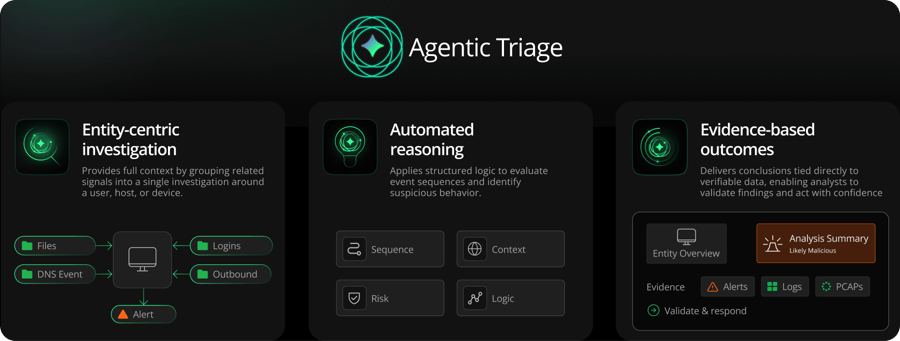
This evolution is known as Agentic Triage. Unlike traditional automation, which handles discrete tasks, Agentic Triage executes full investigative workflows with expert-designed logic while remaining transparent and controllable. It gathers evidence, correlates activity, and produces structured verdicts, shifting the analyst's role from data gathering to high-value decision-making.
Corelight operationalizes this model through a unified, evidence-driven approach to SOC automation. Rather than layering automation onto fragmented workflows, Corelight brings together network telemetry, detections, and investigative context into a single experience that enables analysts to immediately act on structured insights.
At the center of this approach is Corelight Investigator, a SaaS-based Network Detection and Response platform that transforms high-fidelity network data into analyst-ready investigations. Investigator provides a single interface for viewing alerts, visualizing activity across entities, and accessing supporting evidence such as logs and PCAPs. Analysts can move seamlessly from high-level summaries to deep validation without leaving the workflow.
Within Investigator, Agentic Triage executes investigations on behalf of the analyst by applying expert logic, assembling evidence, and delivering clear findings. This enables a shift from manual triage to validation and response.
Key elements of this approach include:
- Executes expert-designed playbooks: Automates Tier 3-level investigative steps with consistency and rigor across all cases
- Shifts to entity-centric investigations: Consolidates related alerts into a single investigation for complete visibility
- Automates evidence gathering and correlation: Collects and analyzes data across telemetry and historical context without manual effort
- Delivers clear, structured verdicts: Produces transparent, evidence-backed findings that are easy to understand and act on
- Reduces investigation time dramatically: Converts hours of manual triage into minutes of review
- Maintains direct access to raw evidence: Ensures all conclusions can be validated with logs and PCAPs for forensic confidence
By embedding Agentic Triage directly into Investigator, Corelight enables SOC teams to operate faster, more consistently, and with greater confidence. Investigations become scalable, evidence-driven, and far less dependent on manual effort, allowing teams to handle higher volumes without increasing complexity or analyst fatigue.
Outcomes for SOC teams
An investigation-centric approach to SOC automation delivers measurable improvements in both operational efficiency and security effectiveness. By reducing manual effort and increasing consistency, teams can scale without sacrificing quality.
Achieve 10x faster triage: Automated investigations eliminate repetitive steps, enabling analysts to move from detection to validated conclusions significantly faster.
Handle 3x more cases per analyst: By reducing time spent on manual analysis, analysts can process more investigations without increasing workload or headcount.
Reduce alert fatigue and burnout: Eliminates the need to review large volumes of low-value alerts, allowing analysts to focus on meaningful, high-priority threats.
Improve investigation quality: Standardized playbooks ensure every investigation follows best practices, reducing variability across analysts and shifts.
Elevate analyst capabilities: Provides junior analysts with pre-analyzed context and guided workflows, enabling them to perform higher-level investigations with confidence.
As a result, SOC teams can transition from reactive, alert-driven operations to proactive, investigation-driven workflows. This shift enables faster response times, more consistent outcomes, and a more scalable approach to defending against increasingly sophisticated threats.
Conclusion
SOC automation is no longer about simply reducing manual effort; it is about fundamentally rethinking how security operations function in an environment defined by speed, scale, and complexity. Traditional approaches that focus on task automation are insufficient to meet modern demands. Instead, organizations must adopt models that automate entire investigations, delivering complete, evidence-backed outcomes rather than incremental efficiencies.
By combining high-fidelity network evidence with agentic AI-driven workflows, Corelight provides a path to more effective, scalable security operations. This approach enables teams to move faster, operate more consistently, and make decisions with greater confidence. As adversaries continue to leverage automation and AI, defenders must do the same, not just to keep up, but to regain the advantage.
Book a demo
We’re proud to protect some of the most sensitive, mission-critical enterprises and government agencies in the world. Learn how Corelight’s Open NDR Platform can help your organization mitigate cybersecurity risk.