- Key takeaways
- What is AI-enabled incident triage, and how does it work?
- Moving from alert fatigue to AI-enabled incident triage
- Benefits and limitations of AI-powered incident triage
- Why network evidence matters for agentic triage
- Measuring success: Key metrics for AI-enabled incident management
- Preparing your organization for agentic AI adoption
- The SOC evolution checklist
- FAQs
Move your SOC from alert fatigue to AI-enabled incident triage. Autonomous agents grounded in network evidence cut triage from hours to minutes.
The modern Security Operations Center (SOC) is facing a critical reckoning. As digital attack surfaces expand across multi-cloud environments, decentralized networks, and hybrid workforces, the volume of security telemetry has reached a point of diminishing returns. For years, the cybersecurity industry promised that Security Orchestration, Automation, and Response (SOAR) would be the ultimate solution to this deluge of data. Yet, for many CISOs, legacy SOAR platforms have merely shifted the operational burden from "analyst burnout" to "automation maintenance fatigue."
We are now entering a new era: AI-enabled incident triage. By moving beyond rigid, brittle scripts and entering the realm of autonomous agents capable of complex reasoning, organizations can finally address the root causes of SOC inefficiency. This guide explores the strategic transition to agentic triage, the critical role of network evidence, and how to build a resilient, AI-powered defense architecture.
Key takeaways
- The scalability gap: Traditional manual triage is linear and resource-constrained; agentic triage scales exponentially, allowing security teams to process thousands of complex alerts simultaneously.
- Reasoning over automation: While legacy automation relies on deterministic "if/then" triggers, modern AI incident triage focuses on dynamic, context-based reasoning, drastically reducing false positives.
- The network anchor: To minimize AI hallucinations, autonomous security agents must be built on "ground truth" telemetry, specifically, high-fidelity, immutable network data.
- Human-centric security: The ultimate goal of AI-enabled incident management is not to replace human talent, but to elevate analysts from data processors to strategic threat hunters.
What is AI-enabled incident triage, and how does it work?
AI-enabled incident triage is the application of artificial intelligence, specifically machine learning (ML), large language models (LLMs), and autonomous agents, to automatically ingest, analyze, prioritize, and investigate security alerts with minimal human intervention. In a traditional SOC setup, an alert is a simple notification of a potential problem that requires tedious manual review. In an AI-enabled ecosystem, an alert acts as a dynamic request for an automated forensic investigation.
Instead of requiring tier-1 security analysts to manually parse through thousands of individual logs, an AI-powered incident analysis system operates as an autonomous force multiplier.
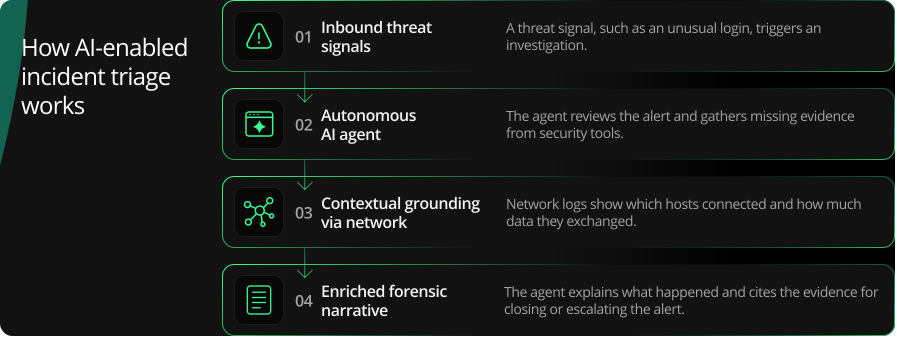
The anatomy of an AI triage agent
Unlike a standard automation script, an AI agent is designed to achieve an abstract goal rather than blindly follow a hard-coded list of instructions. This is the core of agentic triage. These systems utilize a Reasoning and Acting (ReAct) framework to mimic human intelligence at machine speed:
- Ingestion & perception: The agent continuously monitors the alert stream. When a detection occurs, such as a suspicious anomaly-based detection signal, the agent ingests the raw metadata.
- Contextual reasoning: The agent evaluates the alert against internal logic tables, asking itself questions: Is this IP address internal or external? Has this user logged in from this geographic location before? What does the surrounding telemetry look like for this specific timestamp?
- Iterative investigation: If the initial data is inconclusive, the agent autonomously decides to query other security tools, such as an endpoint detection and response (EDR) agent or a network detection and response (NDR) sensor, to actively harvest missing evidence.
- Synthesis & disposition: Finally, the agent produces a natural language narrative summary, adjusts the alert severity based on its findings, and either safely suppresses the event as a false positive or escalates it to a human analyst with a fully pre-packaged investigation file.
How AI-powered incident analysis reconstructs an investigation
Investigating a network breach or system compromise is rarely about evaluating a single point-in-time event; it is about reconstructing a complex sequence of historical events. This is where AI-powered incident analysis and AI for incident investigation become critical operational force multipliers.
When a human analyst looks at a security console, they spend precious time piecing together a coherent story across disparate tools. An AI-enabled incident management system performs this data correlation automatically by "chaining" related events together. For instance, an autonomous agent might analyze the following sequence in real time:
- An unusual, out-of-schedule login in the HR department.
- A suspicious PowerShell command execution on that specific host.
- An encrypted outbound network connection to an unclassified external IP address.
While a human analyst might take hours to correlate these three events across three separate security dashboards, an AI agent can do so in milliseconds. It synthesizes the data and presents the CISO with a cohesive, actionable story: An HR workstation was compromised through credential theft, resulting in local data staging and potential exfiltration.
Moving from alert fatigue to AI-enabled incident triage
For years, SOCs have relied on an alert-centric workflow that is fundamentally broken. Traditional single-point security systems generate a massive volume of disparate alerts. This alert fatigue has a severe impact on SOC performance and remains a primary driver of industry-wide analyst burnout. The situation is exacerbated by a global cybersecurity workforce gap of millions of unfilled positions, leaving the vast majority of current security professionals struggling with unsustainable workloads.
Simultaneously, the threat landscape is evolving rapidly. Adversaries are actively leveraging generative AI to automate reconnaissance, scale sophisticated phishing campaigns, and accelerate attack execution. To survive, SOCs must transition from an alert-centric model to an investigation-centric workflow.
This paradigm shift requires moving away from viewing raw, isolated events and toward reviewing deeply contextualized incidents. By embedding AI for incident triage into the core of operations, security teams can abandon purely reactive workflows and embrace proactive, automated reasoning that matches the speed and scale of modern, AI-driven cyber threats.
How agentic triage differs from legacy SOAR
Traditional SOAR platforms rely on deterministic playbooks. If event "X" happens, execute step "Y." This rigid architecture works well for simple, predictable tasks like automated password resets, but it completely fails during complex incident response. If an advanced persistent threat (APT) changes its tactics slightly, the playbook breaks. CISOs frequently find that their highest-paid security engineers spend a large share of their time troubleshooting and fixing broken Python scripts in their SOAR platforms.
Agentic triage introduces unprecedented flexibility. Because autonomous agents understand natural language and logical abstractions, they can adapt on the fly to variations in alert formats and adversarial behavior. They do not just follow a rigid path; they actively navigate toward a logical conclusion.
Comparison of manual, SOAR, and agentic workflows
| Feature | Manual triage | Legacy SOAR | Agentic AI triage |
|---|---|---|---|
|
Logic basis |
Human experience |
Hard-coded playbooks | Dynamic reasoning |
|
Speed per alert |
15–45 minutes |
2–5 minutes | < 30 seconds |
|
Adaptability |
High (but slow) |
Low (Fragile) | High (Autonomous) |
|
Data silos |
Manual correlation |
API-dependent | Cross-functional synthesis |
|
Primary output |
Investigation note |
Completed task | Forensic narrative |
Benefits and limitations of AI-powered incident triage
As with any transformative enterprise technology, CISOs must objectively weigh the strategic benefits against the near-term operational challenges.
The benefits
A lower SOC "noise floor": Resource-constrained SOCs are forced to "tune out" lower-severity alerts, and sophisticated attackers hide their activity in those low-severity shadows. AI agents do not suffer from cognitive fatigue; they can tirelessly investigate every "low" and "informational" alert, ensuring subtle indicators of compromise never slip through the cracks.
Radical reduction in MTTR (mean time to respond): By completely automating the primary data-gathering and validation phases, the MTTR drops from hours to mere minutes.
Operational consistency: AI agents apply the same rigorous, multi-layered analytical logic at 3:00 AM on a holiday weekend as they do at 10:00 AM on a business Tuesday.
Enhanced analyst retention: By removing the grueling "drudge work" of manual alert scrubbing, agentic triage frees tier-1 and tier-2 analysts to focus their talent on high-value initiatives such as proactive threat hunting.
Headcount decoupling: Organizations can scale their total security ingestion and capacity exponentially without requiring a linear, costly increase in SOC headcount.
The limitations & challenges
The "black box" problem: If an autonomous agent dismisses an alert as a false positive, the SOC must be able to audit “why” that conclusion was reached. Transparency in the agent's step-by-step reasoning is non-negotiable for compliance and defense-in-depth.
Market "agentwashing": The security market is currently flooded with vendors misleadingly rebranding basic, static AI chatbots or search assistants as true "autonomous AI agents." True agentic triage requires independent reasoning, multi-step planning, and tool orchestration.
Data dependency: AI algorithms are entirely dependent on the quality and coverage of their data inputs. Poor, fragmented, or missing telemetry directly results in inaccurate triage decisions and heightened operational risk.
Why network evidence matters for agentic triage
There is a growing, well-founded concern in the cybersecurity community about AI hallucinations, instances when an LLM or AI model invents facts or reaches unsupported conclusions. In a mission-critical SOC environment, an AI hallucination is not just an inconvenience; it is a severe security risk.
The most reliable way to minimize AI hallucinations and build trust in autonomous operations is to ground the triage agent in verifiable, ground-truth data.
The network never lies
Endpoints can be compromised, local operating system logs can be tampered with, and EDR agents can be bypassed or disabled by sophisticated rootkits. The network is different. If a threat actor moves a packet across the physical or virtual wire, it leaves a trace in captured telemetry that the attacker cannot retroactively edit. This makes comprehensive network visibility the most critical input for dependable agentic triage.
Grounding AI in high-fidelity network evidence
High-fidelity network data, such as rich Zeek and Suricata telemetry, acts as the deterministic anchor for AI threat detection. When an autonomous agent is tasked with triaging an ambiguous alert, it can immediately query network logs to verify historical activity:
Byte counts
Was there a significant, anomalous transfer of data following the alert?
Protocol integrity
Was the outbound SSH traffic actually running standard cryptographic controls, or was it an unapproved proxy tunnel masking data exfiltration?
Connection patterns
Was this local host suddenly attempting to talk to hundreds of other internal network segments (indicating lateral movement)?
By grounding autonomous workflows in rigorous network evidence, you shift the investigation from probabilistic guesswork based on fragmented logs to an evidence-backed account of what actually happened. Corelight Agentic Triage was built around this evidence-first principle.
How Corelight Agentic Triage grounds AI-enabled incident management in network evidence
Corelight Agentic Triage, available within Corelight Investigator, applies this evidence-first approach to automated investigations. Instead of asking analysts to review hundreds of individual alerts, it consolidates related signals into entity-centric investigations, applies expert-written investigative playbooks, and delivers a single evidence-backed verdict with reasoning an analyst can inspect and verify. Every playbook step, query, and piece of supporting evidence is exposed. This approach is built for SOCs that need automated decisions to be auditable and defensible, and it directly answers the "black box" problem described above. By shifting the investigative lens from isolated alerts to consolidated entity cases, Corelight Agentic Triage delivers verdicts up to 10x faster than manual workflows.
Measuring success: Key metrics for AI-enabled incident management
To justify organizational investments in agentic security workflows, CISOs must evolve traditional SOC performance metrics to reflect the impact of automated reasoning.
1. Triage autonomy rate: This metric tracks the percentage of total inbound alert volume handled by the AI from initial ingestion to final disposition without requiring human intervention. A mature, optimized agentic SOC should aim for an autonomy rate of 70% to 80%.
2. Investigation completeness: When an AI agent escalates an alert to a human analyst, how often does that human need to step away and look for additional context or missing logs? High-performing agents should deliver at least 95% of the context necessary to make an immediate, definitive containment decision.
3. Mean time to triage decision: Unlike standard time-to-detect, this measures how long it takes the organization to definitively determine whether an alert represents a verified threat or a benign false positive. AI-enabled workflows should drive this metric into the sub-minute range.
4. False negative audit rate: A resilient SOC must establish continuous verification. Security teams should periodically audit a randomized sample of alerts the AI agent safely closed or dismissed, ensuring the underlying machine learning models remain accurate and free of operational drift.
Preparing your organization for agentic AI adoption
Transitioning your SOC to an AI-driven operating model is not just about purchasing a new tool; it requires a deliberate cultural and operational shift.
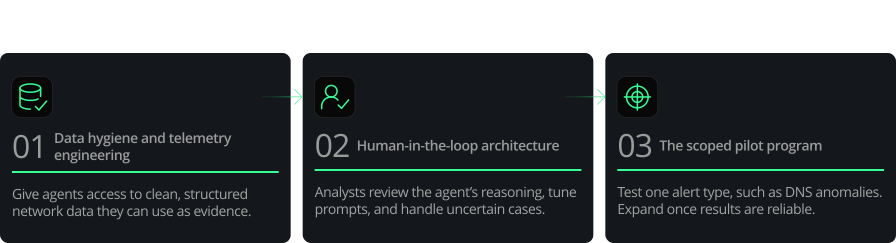
Phase 1: Data hygiene & telemetry engineering
AI is an inherently data-hungry technology. Before deploying agents, ensure your security telemetry is structured, clean, and readily accessible. Prioritize high-fidelity network visibility as your foundational source of truth.
Phase 2: Defining the human-in-the-loop architecture
Reassure security analysts that AI is a career accelerator, not a threat to employment. Retrain tier-1 analysts to act as "Agent Orchestrators." Their primary responsibilities shift to reviewing agent logic, tuning prompt parameters, and handling the highly complex, novel anomalies that the AI flags as uncertain.
Phase 3: The scoped pilot program
Focus your initial agentic deployment on a single, high-volume use case, such as triaging "impossible travel" access alerts or localized DNS anomalies. Once the AI agent consistently demonstrates reliability and sound reasoning within that bounded domain, systematically expand its scope to more complex investigative tasks.
What is the main difference between SOAR and AI incident triage?
Legacy SOAR relies on rigid, deterministic, "if-this-then-that" playbooks designed by human engineers. If a threat actor alters their tactics slightly, the SOAR playbook breaks. AI incident triage uses dynamic, LLM-driven reasoning frameworks to adapt to variations in telemetry formats, contextualize anomalies on the fly, and independently determine the next best investigative action without relying on static scripts.
How does AI-powered incident analysis reduce false positives?
Traditional security tools trigger alerts on isolated events. AI-powered analysis reduces false positives in cybersecurity by automatically correlating an alert with surrounding historical telemetry, user context, and network truth. If an event appears anomalous but its network behavior indicates it is a routine, authorized system process, the AI can safely resolve and automatically close the alert.
Will AI for incident triage replace human SOC analysts?
No. The goal of agentic AI is to eliminate the unsustainable volume of low-value, repetitive alert monitoring that leads to burnout. By automating data collection and preliminary investigations, AI elevates human analysts into strategic operators, allowing them to focus their expertise on complex incident containment, proactive threat hunting, and long-term architectural resilience.
What is the "black box" problem in AI incident triage?
The "black box" problem refers to proprietary AI or machine learning models that make a security decision (such as dismissing or escalating an alert) without explaining how they arrived at that decision. To maintain trust and auditability, organizations should prioritize agentic platforms that use transparent, verifiable reasoning paths and document every step of their automated investigations in plain language.
Why is network data critical for AI-enabled incident triage?
While endpoints, logs, and user identities can be spoofed, manipulated, or disabled by sophisticated attackers, the network remains the ultimate source of truth. Grounding AI agents in high-fidelity network evidence ensures that their reasoning is built on unalterable reality, dramatically reducing the risk of AI hallucinations during critical security investigations.
Book a demo
We’re proud to protect some of the most sensitive, mission-critical enterprises and government agencies in the world. Learn how Corelight’s Open NDR Platform can help your organization mitigate cybersecurity risk.