- Introduction
- What is Zeek?
- How to be successful with Zeek
- When to partner with an NDR vendor
- The power of Zeek scripting in cyber defense
- Why partnering with an NDR solution is critical for scaling Zeek
- Key considerations for evaluating NDR solutions that leverage Zeek
- Why Corelight's open-care approach is the best way to unlock Zeek's full potential
- Conclusion
Unlocking the power of Zeek: A comprehensive primer for security professionals
Introduction
The landscape of modern cybersecurity is defined by an ever-increasing volume of network traffic and an escalating sophistication in adversarial techniques. In this highly complex environment, passive network observation has become an increasingly critical component for defenders seeking to maintain visibility. If you are looking to understand what Zeek is, how it functions, and how to make it work for your organization, you’re in the right place to discover why Zeek is the gold standard of network security monitoring.
A defining characteristic of Zeek is the intentionality and structure of its data. Over the years, the Zeek community has put a tremendous amount of effort into creating security-relevant, protocol-specific logs. Zeek supports an extensive set of logs describing network activity. These logs include not only a comprehensive record of every connection seen on the wire, but also application-layer transcripts. These include all HTTP sessions with their requested URIs, key headers, MIME types, and server responses; DNS requests with replies; SSL certificates; key content of SMTP sessions; and much more. By default, Zeek writes all this information into well-structured tab-separated or JSON log files suitable for post-processing with external software. Users can also choose to have external databases or security information and event management (SIEM) products consume, store, process, and present the data for querying.
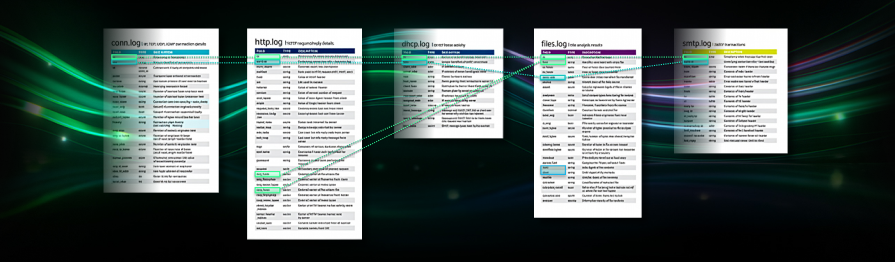
Zeek plays an indispensable role in enabling effective AI adoption for cyber defense. Artificial intelligence models require this kind of high-fidelity, highly structured network metadata to function effectively. As enterprise environments have grown increasingly distributed—spanning on-premises data centers, multiple cloud providers, SaaS applications, and remote endpoints—traditional endpoint detection and response (EDR) solutions alone can no longer provide sufficient visibility. Attackers routinely move laterally across these disparate environments, exploiting gaps between siloed security tools that only see a fraction of the overall picture. Network-level telemetry fills this critical blind spot by observing traffic across all of these environments from a unified vantage point. Given the growing importance of Network Detection and Response (NDR) solutions in modern security programs, especially with the rise of AI, scaling Zeek has become a top priority for enterprise security.
This article will help you understand Zeek’s full potential, identify when to bring in an NDR solution to scale your deployment, evaluate NDR solutions effectively, and determine how Corelight's open-core approach can support organizations that require fully supported deployments.
Originally developed in 1995 by Vern Paxson at Lawrence Berkeley National Laboratory under the name "Bro," the open-source project was designed to monitor high-speed research networks, and measure the growth of the internet. It soon became indispensable to the security team, marking the beginning of a 20-year collaboration between researchers and operations to build Zeek into the powerful security tool it is today. In 2018, the project was rebranded as Zeek to distance the community from negative connotations and to signal a inclusivity and professional excellence. Today, Zeek is maintained by a global team of researchers, engineers, and a vibrant open-source community, with stewardship from Corelight.

Core capabilities
Zeek operates out-of-band as a comprehensive network traffic analyzer, taking a copy of raw network traffic and focusing on deep packet inspection and protocol analysis rather than simple signature matching. Zeek generates rich, structured network metadata through a two-layer architecture:
Event engine
Written in C++, this layer efficiently captures raw packets and reduces them into policy-neutral "events" (e.g., an HTTP GET request being sent) without judging whether the activity is malicious.
Policy script interpreter
This layer executes custom logic using Zeek's domain-specific scripting language, allowing security teams to define exactly how the system should respond to those events, including creating security relevant logs and generating alerts from sophisticated behavioral detections.
Use cases
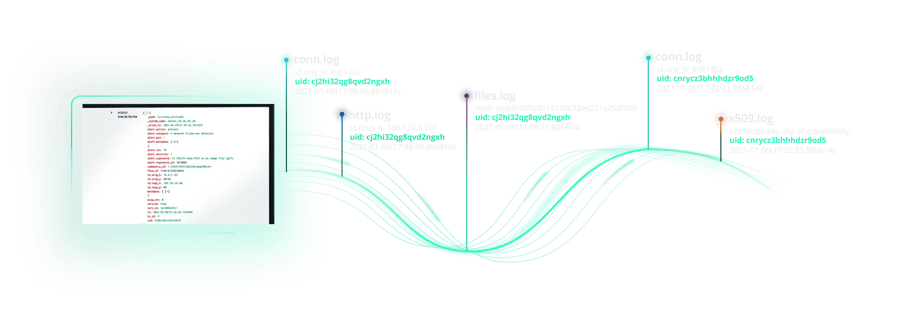
Zeek's primary applications include advanced threat detection, incident response, and in-depth network forensics and threat hunting. By automatically assigning a unique Connection ID (UID) to each observed network flow, Zeek allows analysts to seamlessly link a foundational connection summary (conn.log) directly to application-layer transcripts, like an HTTP transaction (http.log) or a file extraction (files.log). This empowers defenders to quickly reconstruct complex attack timelines with absolute precision.
What makes Zeek especially powerful is the depth of capability behind these use cases. Zeek's domain-specific scripting language gives security teams the flexibility to write custom detection logic tailored to their specific environments, from identifying beaconing patterns to flagging anomalous certificate chains. The Intel Framework allows organizations to ingest large volumes of threat intelligence indicators, such as malicious domains, IP addresses, or file hashes, and automatically match them against live network traffic in real time. Similarly, the Input Framework enables Zeek to pull in external data sources dynamically, keeping detection logic current without manual intervention.
Zeek also excels at automated file extraction, carving files directly from network sessions for downstream analysis by sandboxes or antivirus engines. Its support for multiple output formats (including JSON and TSV) makes it straightforward to integrate Zeek data into virtually any SIEM, data lake, or analytics platform. For organizations with unique protocol environments, Zeek's architecture supports custom protocol analyzers, enabling teams to extend visibility into proprietary or niche protocols that commercial tools often overlook.
Together, these capabilities make Zeek far more than a passive monitor; it is a highly extensible framework that security teams can continuously adapt to meet evolving threats and operational requirements.
Building expertise
Because Zeek is a highly customizable framework, organizations must invest in training and resources to deeply understand Zeek’s capabilities and its event-driven scripting language. Security teams can actively leverage the global Zeek community for support, best practices, and the hundreds of community-contributed packages available via the Zeek Package Manager (zkg).
Establishing a strong foundation
Learning how to run Zeek effectively begins with strategic deployment. Zeek needs to be deployed out-of-band at critical network segments via SPAN ports, optical taps, or cloud traffic mirroring. Proper configuration and tuning, such as ignoring low-risk, long-running flows are essential for minimizing noise and maximizing actionable insights. Organizations should also invest early in developing custom scripts tailored to their environment, using Zeek's event-driven scripting language to define site-specific detection logic, enrich logs with internal context like asset ownership or network zone classification, and automate responses to known threats. A well-maintained library of custom scripts becomes a force multiplier, turning Zeek from a general-purpose monitor into a tool precisely calibrated to your organization's risk profile.
Integrating with your security stack
Zeek should not operate in a vacuum. It is most effective when combined with SIEMs, SOAR platforms, and threat intelligence feeds for enriched analysis. For example, Zeek's Intelligence Framework allows organizations to ingest massive volumes of threat intelligence data (like malicious IPs or file hashes) and match them against live network traffic in real time, outputting the findings to an intel.log.
Zeek's logs are not rigid or fixed; they are designed to be extensible and adaptable to each organization's unique environment. Security teams can add custom fields to existing logs, create entirely new log streams, or modify default logging behavior to capture the metadata that matters most to their operations. The Zeek Package Manager (zkg) provides access to hundreds of community-contributed packages that extend Zeek's functionality out of the box, from additional protocol analyzers to specialized detection scripts. As a result, as your security stack evolves and your integration requirements change, Zeek's output can be tailored to match, ensuring that the data flowing into your SIEM or analytics platform is always relevant, structured, and aligned with your team's specific workflows.
Operationalizing Zeek
To make Zeek work for you, your team must develop strict workflows for monitoring, alerting, and incident response based on Zeek logs. Security analysts should regularly review and update Zeek scripts to adapt to evolving threats, using tools like Zeek's Notice Framework to effectively decouple the detection of notable events from the generation of active alerts.
Beyond reactive alerting, Zeek's rich metadata is equally valuable for proactive threat hunting. Analysts can query Zeek logs to surface subtle indicators of compromise (such as unusual DNS query patterns, unexpected outbound connections, or anomalous TLS certificate usage) that automated rules may not yet detect. And Zeek's utility extends beyond security. Network operations teams regularly use Zeek data for general network troubleshooting, capacity planning, and performance analysis, identifying issues such as misconfigured services, degraded application performance, or unauthorized devices on the network. By operationalizing Zeek across both security and IT operations, organizations maximize the return on their investment and embed network visibility into everyday workflows.
Measuring success
Finally, prove Zeek's value by defining key performance indicators (KPIs) such as reduced detection time, improved threat visibility across the attack surface, and enhanced incident response efficiency.
When to partner with an NDR vendor
While Zeek provides an exceptionally powerful foundation for network security monitoring (NSM), there are natural operational limits to a "do-it-yourself" (DIY) deployment. Zeek excels at generating rich, structured network metadata, but transforming that telemetry into a fully operationalized detection and response capability requires additional tooling, integrations, and ongoing management that can quickly exceed what most teams can sustain in-house.
It is time to consider a commercial NDR solution when:
The network traffic volume has outgrown your current Zeek deployment and you are experiencing packet loss or degraded sensor performance.
Zeek is the gold standard for network security monitoring, and an NDR solution is the operational layer that scales it into a full detection and response program. The transition from DIY to a commercial platform is not a reflection of Zeek's limitations; it is a recognition that enterprise-grade security operations demand enterprise-grade support.
Scenarios where NDR solutions shine
Rapid growth
Expanding enterprise networks, hybrid environments, or new cloud deployments require highly scalable and flexible solutions.
Advanced threats
Detecting sophisticated, stealthy attacks requires machine learning (ML) and behavioral analytics that go beyond traditional scripting.
Compliance requirements
Organizations facing strict regulatory standards require enhanced reporting, long-term data retention, and audit capabilities.
Resource constraints
Security operations centers (SOCs) with limited staff or budget need platforms that automate deployment and management.
Partnering with an NDR vendor early allows you to avoid operational bottlenecks, eliminate infrastructure troubleshooting, and ensure seamless scaling. It grants your team immediate access to advanced features, ML detections, and expert support, maximizing Zeek’s true potential.
The power of Zeek scripting in cyber defense
In addition to being a powerful network analysis framework, Zeek is renowned for its scripting capabilities, which make it highly effective for behavioral detection. Zeek scripts allow users to define custom logic for monitoring and analyzing network traffic, with the ability to identify specific patterns and behaviors across related network sessions. This flexibility is particularly valuable because it allows security teams to craft tailored scripts that align with their unique network environments and threat models. Behavioral detections can help identify malicious or suspicious activities by analyzing network behavior patterns, comparing them against pre-defined behavioral thresholds, often in combination with indicators of compromise (IOCs). By focusing on protocol analysis and event-driven scripting, Zeek excels at surfacing activity that may indicate malicious intent, such as unusual login patterns, data exfiltration attempts, or protocol misuse.
Behavioral alerts can be mapped to the MITRE ATT&CK framework and enriched with additional context, providing analysts with the “why” of the attack along with the context of where the alert fits within the broader attack chain, accelerating investigation and response.
Another key advantage of Zeek's scripting capabilities is its lightweight nature compared to AI-powered detection solutions. While AI and machine learning (ML) models often require significant computational resources for training and inference, Zeek scripts operate efficiently in real-time, leveraging predefined logic rather than resource-intensive algorithms. This makes Zeek an excellent complement to supervised machine learning and anomaly detection systems. ML models excel at identifying patterns in large datasets and uncovering unknown threats, while Zeek scripts provide a deterministic and transparent layer of detection that can validate or enrich ML findings. Together, these approaches create a robust, multi-layered defense strategy that combines the precision and efficiency of Zeek scripting with the adaptability and predictive power of ML-based solutions.
Learn more about multi-layered threat detection
Why Zeek is critical to effective AI adoption in cyber defense
Artificial intelligence models are only as effective as the data on which they are trained. If you are wondering what Zeek logs actually provide to these models, the answer is foundational context. Zeek supplies high-fidelity, structured network metadata, often formatted in easily parsed JSON, that serves as a rich, organized foundation for AI-driven analytics.
Because Zeek's detailed logs break down network sessions into logical, protocol-specific transcripts, AI can leverage this metadata to drastically improve threat classification, behavioral analysis, and predictive modeling. Zeek enables AI to detect subtle patterns and anomalies like DNS tunneling or lateral movement that might otherwise go entirely unnoticed.
Zeek's log format has become the de facto industry standard for structured network metadata, widely adopted across security tools, research institutions, and training datasets. As a result, Zeek's data structures are already used to train most major foundational AI models, giving these models a built-in understanding of Zeek's schema, field relationships, and protocol semantics. Organizations that feed Zeek data into AI-driven workflows are not only providing high-quality input; they are speaking a language these models already understand.
Zeek’s ability to process and analyze network traffic in real time ensures that AI systems and machine learning models always have access to up-to-date, accurate data for autonomous decision-making. Emerging technologies such as AI-powered threat hunting, automated incident response workflows, and proactive risk management are dramatically enhanced when fueled by Zeek’s comprehensive data.
Without the context provided by Zeek, AI systems powering network security and SOC operations may lack the depth and granularity of data needed to deliver accurate, actionable results. Raw packet captures alone are too noisy and unstructured for AI models to process efficiently, while flow data and NetFlow summaries lack the protocol-level detail required for meaningful analysis. Zeek effectively bridges this critical gap between raw network traffic and structured, actionable intelligence, making it a cornerstone of AI-driven network defense strategies.
Read up on our agentic test harness experiment using Zeek and Corelight data
Why partnering with an NDR solution is critical for scaling Zeek
Scaling Zeek independently introduces a highly resource-intensive deployment and management process. It requires specialized expertise to configure hardware, manage network interface card (NIC) drivers, tune Linux performance, and maintain custom scripts. DIY deployments often take weeks or months to finalize, distracting security teams from using the tool.
Commercial, Zeek-powered network detection and response (NDR) platforms eliminate these operational hurdles by dramatically simplifying Zeek deployment and fleet scaling across distributed enterprise environments. NDR solutions built on Zeek, such as Corelight’s Open NDR Platform, enhance Zeek's core capabilities with advanced analytics, automated SIEM integrations, and user-friendly management interfaces.
By leveraging Corelight's NDR platform, security teams can significantly improve threat detection and response times. Organizations benefit from reduced operational overhead, greater efficiency, and the ability to maintain seamless visibility across tens or hundreds of gigabits of traffic.
Key considerations for evaluating NDR solutions that leverage Zeek
When evaluating enterprise NDR platforms designed to scale Zeek, security leaders should prioritize the following criteria:
Integration with Zeek: Assess how well the NDR solution integrates with, supports, and enhances Zeek's foundational functionality and open-source packages.
Scalability and performance: Ensure the platform can handle large-scale, high-traffic environments without packet loss (e.g., scaling to 100+ Gbps per sensor).
Advanced features: The solution should include native machine learning, integrated threat intelligence, and behavioral analytics mapped to frameworks such as MITRE ATT&CK.
Support and community: Ensure the vendor provides 24/7 expert support and actively fosters the broader open-source user community.
Cost and ROI: Balance the financial investment against the tangible value delivered, such as reduced SIEM ingest costs and lowered operational overhead.
Why Corelight’s open-core approach is the best way to unlock Zeek’s full potential
Corelight was founded by Vern Paxson and the core technologists behind Zeek, and the Zeek team continues to operate primarily with Corelight’s support. Corelight’s Open NDR platform is built directly on Zeek’s open-source foundation, and includes enterprise-grade enhancements designed to remove operational friction.
This open-core approach promotes transparency, flexibility, and rapid innovation driven by the global open-source community. By using standard formats such as JSON and TSV, Corelight ensures seamless integration with existing tools, such as Splunk or Elastic, while reducing vendor lock-in.
When evaluating any NDR platform, security leaders should consider how well it preserves and extends Zeek's open-source foundation, rather than replacing or abstracting it away. Corelight stands apart in this respect by offering turnkey deployments in under 15 minutes, a sharp contrast to the weeks often required for DIY setups. The platform features high-performance sensors capable of processing 125+ Gbps, enriched metadata mapped to more than 80 MITRE ATT&CK techniques, and advanced threat detection powered by supervised machine learning. Corelight also provides comprehensive training, 24/7 support, and seamless fusion of Zeek's deep network evidence with signature-based alerts tools such as Suricata.
Enterprises use Corelight to scale Zeek to massive traffic volumes while drastically reducing their operational costs. Through features such as Data Aggregation and comprehensive log filtering, Corelight can reduce network log volume by as much as 80% compared with Zeek alone, consolidating data to enable much faster investigation speeds without sacrificing critical forensic visibility.
Conclusion
Zeek has undeniably cemented its importance as a foundational platform for modern network security. Evolving from a simple traffic analyzer into a comprehensive framework that translates raw packets into the rich, structured telemetry defenders need to investigate threats effectively. Furthermore, Zeek plays an indispensable role in enabling effective AI adoption for cyber defense, as machine learning models rely heavily on its high-fidelity metadata.
However, as enterprise networks grow faster and more complex, relying solely on DIY deployments becomes increasingly unsustainable. NDR solutions are essential in scaling and enhancing Zeek to meet enterprise demands. Ultimately, Corelight’s open-core approach stands out as the optimal choice for enterprises, offering the perfect balance of open-source adaptability and enterprise-grade scalability.
Book a demo
We’re proud to protect some of the most sensitive, mission-critical enterprises and government agencies in the world. Learn how Corelight’s Open NDR Platform can help your organization mitigate cybersecurity risk.