
Incident response
Drive future-ready defense with automated triage multi-layer detections and integrated ecosystem response.
Contain threats at machine speed
Resolve incidents up to 10x faster with autonomous AI investigations, instant forensic pivots, and integrated one-click incident response across your entire security stack.
How Corelight uses AI to streamline the entire incident response lifecycle
Intelligent prioritization
Entity-centric consolidation groups hundreds of isolated alerts into a single, evidence-backed investigation per entity, eliminating the repetitive review steps that consume your shifts.
AI assistance
Every AI verdict is backed by plain-language explainers that show what triggered the finding and why, so you can validate, challenge, or act with confidence.
Instant pivoting
From a single investigation view, move from entity summary to session logs to raw packets in seconds without changing context.
Integrated response
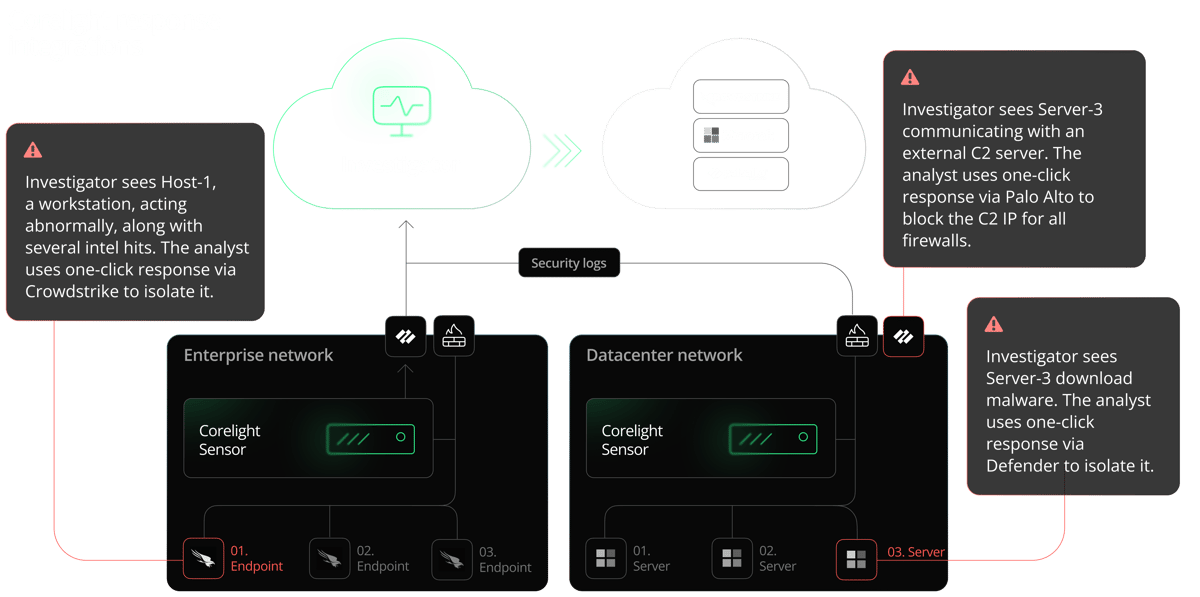
Connect investigations directly to action. With a single click, isolate compromised hosts in your EDR platform and enforce network containment through your firewall.
Uses cases
Agentic triage for incident response
Agentic AI triage accelerates incident response by automatically consolidating alerts into an entity-centric investigation. Expert-authored playbooks collect evidence, explain findings, and prioritize risk, enabling analysts to respond faster with confidence, consistency, and defensible decisions during active incidents.
Incident blast radius mapping and scope assessment
Corelight provides authoritative network evidence to map incident impact. By indexing file metadata from network traffic, teams can trace payload propagation, identify every affected host, uncover lateral movement across SMB and RDP, and deliver an accurate, evidence-backed scope assessment.
Enable fast host isolation and containment
Integrate with SOAR, EDR, and firewalls to enable rapid containment. Analysts can automate actions such as isolating compromised hosts and blocking malicious traffic, using Corelight evidence to trigger these responses, prevent lateral spread, and limit impact.
Perform post-incident network forensics
Support post-incident network forensics using protocol logs, file metadata, and Smart PCAP. Analysts can reconstruct sessions, validate attacker behavior, and trace data movement to produce defensible evidence for incident reports and compliance needs.
Unified attack timeline reconstruction
Corelight automatically synthesizes complex, multi-stage attack activity into a single, coherent investigation timeline. By correlating network evidence across protocols, hosts, and time, responders gain clear visibility into attacker actions, accelerate understanding, and drive faster, more confident containment and remediation decisions.
Integrate response into SOC workflows
Integrates with SIEMs, SOARs, XDRs, and cloud security tools to enrich alerts with network context. Consistent, Zeek-based telemetry across on-premises and cloud environments ensures that network intelligence is embedded directly into SOC workflows.
Gartner® and Peer Insights™ are trademarks of Gartner, Inc. and/or its affiliates. All rights reserved. Gartner Peer Insights content consists of the opinions of individual end users based on their own experiences, and should not be construed as statements of fact, nor do they represent the views of Gartner or its affiliates. Gartner does not endorse any vendor, product or service depicted in this content nor makes any warranties, expressed or implied, with respect to this content, about its accuracy or completeness, including any warranties of merchantability or fitness for a particular purpose
Very impressed with the time and effort saved during hunting operations as well as triage/incident response and in-depth investigations.

IT Security & Risk Management Associate, Government
Gartner® and Peer Insights™ are trademarks of Gartner, Inc. and/or its affiliates. All rights reserved. Gartner Peer Insights content consists of the opinions of individual end users based on their own experiences, and should not be construed as statements of fact, nor do they represent the views of Gartner or its affiliates. Gartner does not endorse any vendor, product or service depicted in this content nor makes any warranties, expressed or implied, with respect to this content, about its accuracy or completeness, including any warranties of merchantability or fitness for a particular purpose
Corelight has proven to be a powerful and efficient solution, to improve our detection and elevate our response capability, as we seek to have a more versatile and robust method of detecting compromise and lateral movement.
CISO/VP, Education
Gartner® and Peer Insights™ are trademarks of Gartner, Inc. and/or its affiliates. All rights reserved. Gartner Peer Insights content consists of the opinions of individual end users based on their own experiences, and should not be construed as statements of fact, nor do they represent the views of Gartner or its affiliates. Gartner does not endorse any vendor, product or service depicted in this content nor makes any warranties, expressed or implied, with respect to this content, about its accuracy or completeness, including any warranties of merchantability or fitness for a particular purpose
In the event of an incident they are there to lead you on the right path.
Cybersecurity Engineer, Education
Open NDR Platform difference
Only Corelight combines transparent expert-authored playbooks with proactive, entity-centric investigations to enable automated triage that performs the work of a SOC analyst at machine speed.
| ExtraHop | Darktrace | Vectra AI | Corelight |
| Proprietary workflows generate summaries and timelines, but the underlying network transactions are locked in a proprietary recordstore and cannot be independently queried outside the platform. | Behavioral AI models produce anomaly narratives and incident summaries, but the investigation output is opaque. There is no published protocol list and no way to independently verify what the AI observed. | Entity-level risk scoring and attack timelines provide prioritization, but investigation depth is limited to 16 metadata types with a 14 day lookback window. | Agentic AI consolidates hundreds of alerts into entity-centric investigations with expert-authored playbooks. Every finding is backed by plain language explainers linked to raw logs and PCAP. |
| ExtraHop | Darktrace | Vectra AI | Corelight |
| Response actions such as host quarantine and device isolation are executed by third-party EDR tools their REST API. ExtraHop provides detection context but cannot contain a host natively. Evidence verification, before response relies on network metadata stored in a proprietary format that requires the platform to access. | Darktrace Respond can take autonomous containment actions, but acts on AI verdicts without exposing the underlying evidence. Analysts cannot independently audit what the AI observed before containment fires. | Lockdown features for hosts, accounts, and traffic appear native in the UI, but every action is executed by a third-party tool. Host isolation requires an integrated EDR. Account lockdown calls identity provider APIs. Traffic blocking publishes IPs to a firewall blocklist. Without EDR, identity, and firewall integrations configured, the platform has no standalone containment capability. | Every response action, whether CrowdStrike host quarantine, Palo Alto Networks firewall block, or Microsoft Entra ID universal logout, is executed directly from the investigation and tied to the specific evidence that justified it. Analysts act with confidence because the evidence is verified before the action is taken. |
| ExtraHop | Darktrace | Vectra AI | Corelight |
| Alert history and behavioral timelines are retained for up to 365 days with a paid Premium Investigation add-on. Data is stored in a proprietary format that requires the ExtraHop platform and an active license to access. | Behavioral history is retained for approximately 30 days with no vendor-managed extension option. The record is not structured as an immutable forensic artifact and cannot be exported for independent verification or regulatory disclosure. | On-platform metadata is retained for 14 days. Extended retention requires a paid Stream add-on plus a customer-owned data lake. The legacy Recall search product is deprecated and unavailable to new customers. | An immutable, off-the-wire record: Compact Zeek metadata for extended lookback, and Smart PCAP for full-packet retention of high-value sessions. Audit-ready for NIS2, DORA, NERC CIP, and SEC material disclosure requirements. |
Case study
Federal SOC reduces average response time by 75% by eliminating manual data collection and automating investigation workflows.
Case study
Global financial firm fully mitigates a sophisticated, multi-platform identity attack across Google Workspace and Slack in less than two hours.
Case study
Global gaming giant successfully thwarts a $10 million ransomware demand by using Corelight to rapidly build an attack timeline and scope the incident in hours, rather than weeks.
Unlocking response workflows
Investigator
Investigator leverages Agentic AI to consolidate fragmented alerts into transparent, entity-centric investigations, accelerate incident response with one-click remediation, and facilitate regional compliance.
Corelight Sensors
Corelight Sensors offer passive network traffic analysis to monitor, analyze, and log network activity. Available as hardware appliances, virtual machines, cloud instances, and software sensors, Corelight has options for your deployment environment requirements.
Smart PCAP
Bridge the gap between high-level metadata and raw packets with Corelight Smart PCAP, a purpose-built forensic solution for security teams. By capturing only the packets that matter Smart PCAP extends forensic retention by up to 10x while embedding 1-click retrieval links directly into your existing SIEM investigative workflows.
Insurance giant speeds Citrix response
Situation
A large insurance organization faced a critical need to assess exposure and exploitation during the widespread Citrix VDI vulnerability.
They needed fast, reliable visibility into historical network activity to validate exposure and avoid wasting time chasing hypothetical risks.
Challenge
Prior to Corelight, answering “Are we vulnerable?” and “Were we exploited?” required weeks of manual investigation and was often deprioritized due to competing alert queues and limited resources.
Solution
Corelight provided historical network data that allowed the security team to answer those key questions in just 20 minutes instead of weeks.
Results
The team dramatically reduced investigation time and was able to focus its limited resources on high-impact, mission-critical security work.
Maximize ROI with services and training from Corelight
Corelight Services and Training puts elite defense within reach by ensuring your team can maximize the value of our Open NDR Platform. From precision deployment and SIEM integration to activity-based training from world-class experts, our services provide the technical guidance needed to accelerate SOC maturity.
-
Accelerate implementation and time to value with health checks
-
Precision engineering for detection calibration, and customization
-
Expert-led training and education services

FAQ
What are the most important steps in an alert triage process?
A critical step in the alert triage process is aggregating and prioritizing alerts by risk to effectively filter out noise. The process should consolidate hundreds of isolated alerts into a single, entity-centric investigation. AI-assisted triage and guided workflows can automate this by collecting evidence, explaining findings in plain language, and prioritizing risks. This allows analysts to validate findings and act on defensible evidence instead of repeating manual review steps.
What are some tips for accelerating incident response?
To accelerate incident response, security teams should leverage autonomous AI investigations and instant forensic pivots that don't require switching tools. By linking alerts directly to relevant network logs and packet capture (PCAP) data via unique identifiers, analysts can instantly move from a high-level alert to deep forensic data. Response times can be significantly reduced by automating data collection and utilizing integrated, one-click responses, such as isolating compromised hosts through EDR platforms.
How can I reduce mean time to detect (MTTD) and respond (MTTR)?
Organizations can significantly reduce their MTTR (mean time to respond) and MTTD (mean time to detect) times by implementing an Open NDR Platform with AI-powered workflows. Relying on comprehensive network detection and response evidence rather than fragmented alerts helps eliminate investigative dead ends. Furthermore, having real-time access to synthesized log summaries, automated alert scoring, and actionable next steps enables analysts to move from high-level alerts to raw packets in seconds, dramatically speeding up the response lifecycle.
How can I reduce false positives?
False positives can be minimized by applying a multi-layered detection strategy that combines AI, machine learning, behavioral analytics, and curated signature-based detection to prioritize aggregated alerts based on actual risk. By integrating alerts, network telemetry, and PCAP data via unique identifiers, the triage process is streamlined, naturally filtering out noise so security analysts can focus exclusively on the alerts that truly matter.
How can I find EDR evasive threats?
Finding evasive threats, such as "living off the land" techniques that bypass traditional endpoints, requires deep internal network visibility to uncover lateral movement. Defenders can expose these evasive threats by fingerprinting encrypted connections using techniques like JA3/JA3S hashing and behavioral analytics. This allows teams to track sophisticated threats that blend in with normal HTTPS, SSH, or RDP traffic, providing a clear path for investigations even when decryption is not feasible.